

A Canticle for Leibowitz
Christianity with Rigor

The Offended Cleric
When I was in highschool, a Jesuit Prep school in Los Angeles, our swim coach the first year was Father Conn. He was also the Speech & Debate teacher - the one who made us memorize John Donne in the days when all we sophomores wanted to do was memorize monologues by Richard Pryor and George Carlin. I kinda liked him, but we fell out over a Japanese t-shirt I wore which had a curse word on it. I bought it from Venice Beach and I never learned what the curse word was. In fact, it was the second time I wore it when he told me something to the effect “I thought I told you not to wear that.” My reaction, unspoken, was that I had to take his word that whatever this symbol was, it was offensive. So I basically transferred his disapproval from the shirt to myself and so our disrespect became mutual. The second occasion, by the way, was at soccer practice when I was captain of my intramural team — and we won the tournament which took place after school, when nobody was expected to follow the dress code.
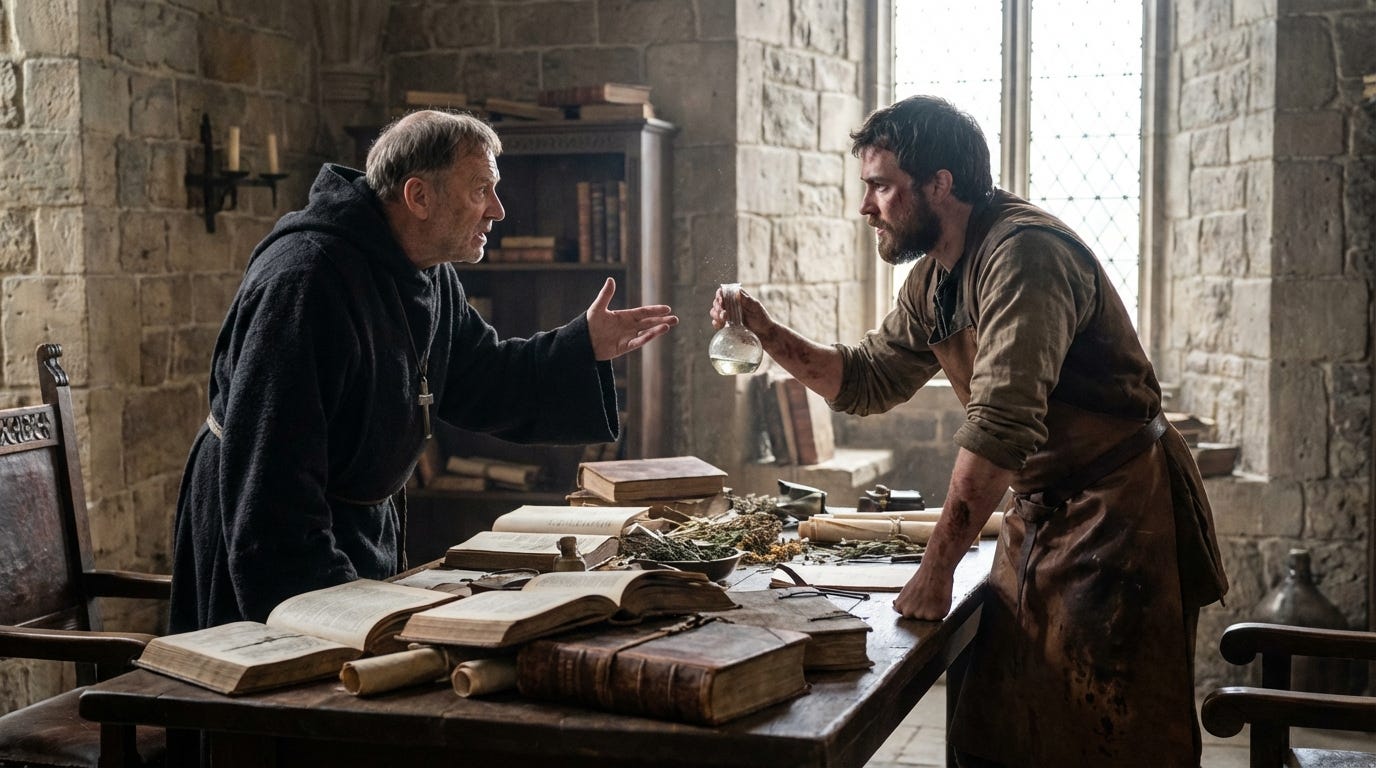
I am reminded of this story because in reading A Canticle for Leibowitz, I get that same strange gist of arrogant Catholic authority as I read the minds of the characters in the monastery, oftimes in Latin. So I wish to focus on Chapter 21 of the book in which emerges a hidden conflict between the Abbott and a secular scholar.
The novel, which I haven’t finished, was published in 1959, and it is the story I should perhaps have read back in 1987 when I was first employed full-time at Xerox in El Segundo. You see, at the time, back when corporate business managers wouldn’t dare touch a computer keyboard, I likened my position in front of my screen for hours on end to be like that of a monastic scrivener. We were engaged in severely rigorous logical gymnastics known only to a few. In these days one of the biggest issues was that of ‘computer literacy’. We were the literate and all around us were the dark ages. I guess I still often think that way.
The Conflict
At any rate, it’s the story (so far) of some very deeply philosophical connections between what we would call discovery and revelation. It takes place in a primitive post-nuclear-apocalytic America in which a religious order comes into contact with a secular scholar. They both have been waiting for centuries for this connection to take place, where the monks and their leader have inherited a tradition of keeping and preserving artifacts from ancient before-fore times. The traveling scholar at long last finds the legendary hall of memorabilia which contain the most beautiful mathematics ever known to mankind. Where the monks don’t quite know what mathematics are and the scholar has never seen an interval or differential equation, yet both parties know there are world historical implications in the understanding.
To wit:
“But you promise to begin restoring Man’s control over Nature. But who will govern the use of the power to control natural forces? Who will use it? To what end? How will you hold him in check? Such decisions can still be made. But if you and your group don’t make them now, others will soon make them for you. Mankind will profit, you say. By whose sufferance? The sufferance of a prince who signs his letters X? Or do you really believe that your collegium can stay aloof from his ambitions when he begins to find out that you’re valuable to him?”
Dom Paulo had not expected to convince him. But it was with a heavy heart that the abbot noticed the plodding patience with which the thon heard him through; it was the patience of a man listening to an argument which he had long ago refuted to his own satisfaction.
“What you really suggest,” said the scholar, “is that we wait a little while. That we dissolve the collegium, or move it to the desert, and somehow-with no gold and silver of our own-revive an experimental and theoretical science in some slow hard way, and tell nobody. That we save it all up for the day when Man is good and pure and holy and wise.”
“That is not what I meant-“
“That is not what you meant to say, but it is what your saying means. Keep science cloistered, don’t try to apply it, don’t try to do anything about it until men are holy. Well, it won’t work. You’ve been doing it here in this abbey for generations.”
“We haven’t withheld anything.”
“You haven’t withheld it; but you sat on it so quietly, nobody knew it was here, and you did nothing with it.”
Brief anger flared in the old priest’s eyes. “It’s time you met our founder, I think,” he growled, pointing to the woodcarving in the corner. “He was a scientist like yourself before the world went mad and he ran for sanctuary. He founded this Order to save what could be saved of the records of the last civilization. ‘Saved’ from what, and for what? Look where he’s standing-see the kindling? the books? That’s how little the world wanted your science then, and for centuries afterward. So he died for our sake. When they drenched him with fuel oil, legend says he asked them for a cup of it. They thought he mistook it for water, so they laughed and gave him a cup. He blessed it and-some say the oil changed to wine when he blessed it-and then: “Hic est enim calix Sanguinis Mei,” and he drank it before they hung him and set him on fire. Shall I read you a list of our martyrs? Shall I name all the battles we have fought to keep these records intact? All the monks blinded in the copyroom? for your sake? Yet you say we did nothing with it, withheld it by silence.”
“Not intentionally,” the scholar said, “but in effect you did- and for the very motives you imply should be mine. If you try to save wisdom until the world is wise, Father, the world will never have it.”
“I can see the misunderstanding is basic!” the abbot said gruffly. “To serve God first, or to serve Hannegan first-that’s your choice.”
“I have little choice, then,” answered the thon. “Would you have me work for the Church?” The scorn in his voice was unmistakable.
M. Miller Jr., Walter . A Canticle for Leibowitz (pp. 286-288). (Function). Kindle Edition.
I do not know what happens in the end of the book, but can guess that humanity is engaged in a cycle of doom from lazy ignorance to hatred of all that slothful ignorance hosts to contempt for ignorant people to the destruction of the same, revealing calculated evil worse than the slothful evil ignorance. We shall see.
The language of this book is absolutely and monumentally compleat. It is like reading a treatise spoken by avatars. Indeed it is a book that reminds me of the film I watched yesterday North by Northwest by Alfred Hitchcock. That film takes us to a time in which American culture seemed settled and perfunctory, with commonplace courtesy and social mores that allowed a kind of social intercourse which seems impossible today. As contemporary writers are talking about our loss of trust in society, I think they’ve nailed something.
This book has one of the best arguments with a priest since The Brothers Karamazov, and the final one at the end of the book (now finished) is probably the most heart-rending I’ve ever encountered. It is the definitive characterization of the responsibilities of authority.
.
Give me a day or so to read it. Then I'll be back with informed commentary.
I've only heard of this book for my whole life. Thanks for the push to read it.