


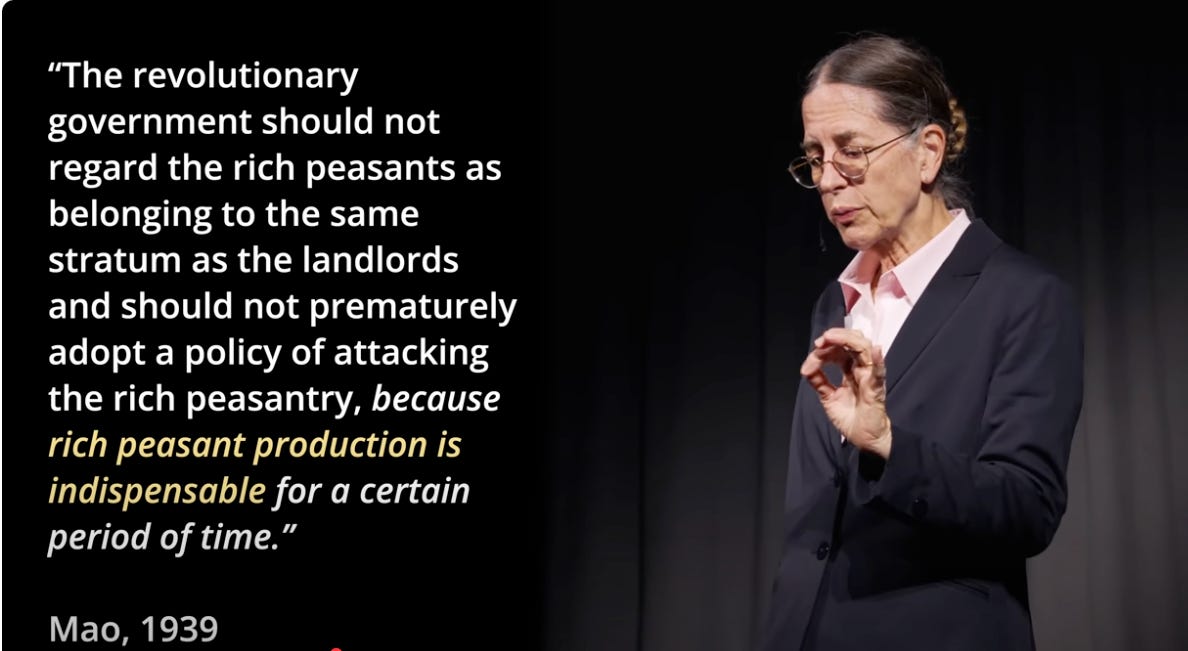
Her name is S. C. M. Paine. She’s a student of grand strategy with a focus on China, Japan and Russia, a genuine Cold War kid like myself. I just discovered her via Dwarkesh Patel. It’s kind of rare that I get to find someone who has been thinking about such big things for a long time. The last person who sat on this particular kind of tuffet was T. P. M. Barnett. He was born a year after me. Pattern here perhaps?
Over the past week have listened to about six hours of her lectures, mostly recorded with Patel. The first book I’ve picked up by her is The Wars for Asia 1911 - 1949. I expect it to transform my understanding of WW2, in a way similar to Dan Carlin’s Ghosts of the Ostfront. Lately I’ve been reading up on the War in the Pacific (With the Old Breed) and separate from that, trying to make sense of Australia’s relationship with China.
What is most impressive to me about Paine’s thinking is that she broadly accepts counter-arguments and makes rebuttals. It’s the kind of thinking you rarely hear. I think one of the reasons for that is that Paine has earned an audience of real thinkers at the US Naval War College. Unlike so many we have accepted as ‘public intellectuals’ she gives no impression that she needs to be any sort of partisan activist. That pose is what ruins those who would educate.
So as I go onto this endeavor, it makes me think a bit about what claims I have made about being a ‘heterodox thinker’. What is it that we are supposed to be so heterodox about? Does our animation come from something more than the perception that we are on ‘the right side of history’? As if history were so binary. I’d say one’s interpretation of history is mostly constrained to what’s produced in our own language, and here again Paine excels by being competent in multiples. She borrows from national histories written in the original languages of the subject countries. It’s an extraordinarily simple thing to recognize, rather like the obvious escape from postmodernist and hedonic sensibilities by reading books written before 1980. The simple fact is that only such seriousness catches my attention; I have to force myself to pay attention to what it is I believe younger and sillier people attend. Still I’m trying to catch the worthy. So I guess it’s discovery after all. We all know this, right?
As for Asia, I expect to get a finer perspective on the larger moves, especially in light of Cambodia’s new beef with Thailand. My traveling bro is in Delhi these days, so safely out of that zone. But more interestingly I’m trying to get a sense of their geopolitical animosities, grievances, and grandiose airs. All too often, the interwebz are showing me those things Americans wish we were doing better and thus feel threatened by Chinese capacity with no deeper understanding of how good they are, how they got that way and whether or not it’s a strategic matter at all. One of my goto’s is Asianometry, which does an excellent job of developments in computing - I especially like this one:
Stories like this should serve to remind us that the sometimes the LLM + RAG or today becomes the Javascript of tomorrow. Ruthless and relentless progress, punctuated by ubiquitous mediocrity, and crushing obsolescence, that’s our digital world. The Japanese lucked their way into blue LEDs and changed the world, but the dogged determination and genius was abused all the way there.
I’m also spending more time thinking about the end of some parts of my ambition, and whether or not actual Buddhism has a place in my future. I’m wondering if I could go Gray Man in India, like I’m fairly sure I could in Fulton County Georgia, or New Haven. I’ve stopped collecting. I’ve started doing curls and remembering the first steps of Taichi.
This week also marks the end of the Basho in Nagoya, in which my favorites {Onosato, Aonishiki, Atamifuji, Wakatakakage and Takaysu} all had winning records. Oh yeah and little Midorifuji too. This is my second romance with Sumo. What I love about it is that it has no weight classes. Step up or step off.
Zero Sum vs Non Zero Probabilities
Tangential to all of this Asian study is a gnawing impatience with American imprudence. Not to make a big deal out of it, but I often get the distinct feeling that our successes are accidental as well. There are always smarter people left out of the frame. There is always a sense that we persist despite our own-goals. It makes me both more paranoid and more arrogant. When the nation’s leaders start playing zero sum games, it increases the probabilities of idiocracy. We keep saying “It could never happen here”, but that is both willful blindness and brinksmanship. Americans double down on whatever seems to be the surest bet regardless of apparent wisdom. So much remains undiscovered, and unremarked upon and unfunded.
So yes, I’m studying myself into yet more obscure corners. Maybe I’m a hedgehog after all. But here’s the thing, that’s a rather Chinese way of thinking. After all, I can specifically remember when my business parter and I engaged for The China Deal in late 2003. The attitude was that it was like The Roaring 20s, everybody building everything and billions to be made. I have come to the understanding reinforcing the idea that China was following an already proven industrialization blueprint innovated by the West 100 years earlier. Of course rural electrification was a great idea. It didn’t take a genius to make that happen, just an iron fist in a glove full of vaseline. When people actually starve, iron fists are sought and found.
The trick then for us peasants is not to find ourselves on death ground - that part of the contest where the leadership has decided these are the hills on which both sides must conflict to the bitterest end.
Books of Interest
Makiya, Kanan. Republic of Fear: The Politics of Modern Iraq. Berkeley: University of California Press, 1998.
Paine, S.C.M. The Wars for Asia, 1911–1949. Cambridge: Cambridge University Press, 2012.
Sledge, E. B. With the Old Breed: At Peleliu and Okinawa. Novato, CA: Presidio Press, 2007.
Sun Tzu. The Art of War. Translated by Samuel B. Griffith. Oxford: Oxford University Press, 1963.
Yang, Jisheng. Tombstone: The Great Chinese Famine, 1958–1962. Translated by Stacy Mosher and Guo Jian. New York: Farrar, Straus and Giroux, 2012.
If you haven't already done so, I recommend Samuel Eliot Morison's exhaustive 16-volume History of U.S. Navy Operations in WWII. It's a surprisingly quick read because Morison could WRITE, so you don't get bogged down in minutiae as one does when reading the Army official history. Morison does a very good job of covering the politics leading up to the war, and few authors are as good at writing concise yet gripping accounts of sea battles. If sixteen volumes seems a bit much, there is a condensed version, The Two-Ocean War.