

Big C, Little C
What begins with C?

That would be cancer, and I’ve got it.
I’ve been wondering since Thursday whether or not I should call myself a cancer survivor. I tried it for the first time at a sushi bar in West LA, and my server told me that he was too. So he told me the tale of his CT scan and his PET scan and some arbitrary numbers and lengths of needles involved between taking other folks’ orders and handing me hand rolls. Now that I think about it he did mention that he had to be isolated because of the radioactive isotopes injected into his veins.
The horror of modern medicine seems to be the only kind we seem to respect in that offhanded way we find reasons to admire anyone calling themselves a cheater of death. “My mother had liver cancer. It’s the easiest kind to get because doctors really know how to chop liver.” That’s true but I haven’t said that in a while. In the meantime she has survived a stroke and thrombosis. She’s doing jumping jacks at age 90 this year. As for me, being a writer, I suppose there’s some measure of public service and another exercise in honest brokerage that I feel a duty to call out some graphic details.
Four Horsemen
Back in the late 90s when I found myself with 3 kids and money problems I decided that I should stake out the four horsemen of the American man’s apocalypse. These are the four things that, if they don’t kill you, make you stronger.
Heart Attack
Felony Conviction
Custody Battle
IRS Audit
I survived the last two but it took me the better part of a decade, or probably more, to get out from under. Well actually, I won in both cases. I won custody of my child and I cleared my debt with the feds. So I felt justified in my strengths, but then one day my doctor told me that I had ‘pre-diabetes’. Looking at me statistically through his dainty lenses, when I told him nobody else in my family had diabetes, he told me that they were lying to me. Did I say ex-doctor? Either way I suddenly got smart about my diet and after a couple sessions with a dietitian specialists I figured out how to get right.
Risk Management
I’m a stubborn cuss, I’ll tell you that straight out. Hardheaded as all get-out. Most of my life has been running double time. If you ask me, I’ll tell you that I never lower the river, I raise the bridge. I back up, sprint and hurdle over stumbling blocks. I don’t want to be led around like some tame donkey. So I have always born the burdens of needing a larger house, bigger cars and more groceries than my middle-class professional peers. That’s what having three children in the house means for a family-first father. It means managing cash to the penny when you don’t have good credit. It means going to cheap dentists. It means lugging an NEC monitor through airports when you cannot afford a laptop. It means no extra bucks for elimination of the dad bod. I’m pretty good with handling risks I can see or anticipate. But all through my beach volleyball games, I didn’t bother to get my A1C checked or do much about my cholesterol. After all, I was winning. Those were things I couldn’t see.
Swivel Head
Starting in 2011, I got the kind of job where I didn’t have to travel. So I finally got to do things locally. That would include Scout parent stuff, Emergency Response training, citizens police training, Crossfit, Tai Kwan Do and pistol shooting. I took off 25 pounds and grew into a very different kind of tactically obnoxious personality. In 2015 my mother suffered her stroke while she was living with me. Somewhere around 2016 my closest brother dropped dead of a blood aneurism. In 2017 my son got a medical discharge from the Navy. I had to John Wayne up, multiple times. But also for myself. I realized, like many men, that I had to keep my head on a swivel and be prepared for shit to break. What I couldn’t afford, what my family couldn’t afford was for me to be the one that broke. Somewhere around that time, when I realized that I was dealing with life and death situations more often than anybody could want, I started listening to this album. This album saved my life. It taught me how to be sad without being pitiful.
PSA - The First Indicator
This started somewhere around October of last year. I funded my last quarter of the year and took a vacation in New Orleans. When I came back I had a doctor’s appointment and blood work that showed my Prostate Specific Antigen (PSA) index was around 6.2 up from 5 in the previous year, when it should be below 4 at my age. He recommended that I should go see a urologist, which I did. By the standard examination Dr. E told me that I have a normal sized prostate which was a good sign. As I am registered to UCLA Health, which is one of the best in the country, I’ve gotten swift referrals. So my next stop was to get an MRI. I figured I should delay that until the new year so I could enjoy my holidays.
Here’s a link to nine technical documents at all levels of detail for your information.
Doctor Talk
Having gotten accustomed to working with various LLMs in tracking my father’s medical issues that I have been attending to for the past two years, I know when to pay them mind and when they get off track. But there really is no substitute for having many frank conversations with many different doctors.
I’m on my fourth primary in seven years. The first was the skinny dainty one who always had a kind of expression that he hated actually touching his patients. The second was the ex-Jiu Jitsu dude who finally let himself go. I really liked Dr. A who worked in sports medicine. A doctor like that will tell you what you need to know when you’re ready to discipline yourself in diet, drugs and exercise. He was perfect for me because I would take the actions, rather than waffle or pretend I could bull through it. He told me that I was on the borderline for prostate cancer, but that I probably shouldn’t investigate further (meaning get a biopsy) because it was a muddy area. He was right, exactly how I’ll tell you later. In the end, that hospital was behind the times with their systems, so they messed up my prescriptions and appointments and I got fed up.
I switched to UCLA Health and they gave me a kid who just finished in Grenada. Anyway I could only put up with him for a year. My current primary, Dr. R is just right. An avid runner who is about ten years older than I am, we grew up in the same neighborhood. He always brings in his assistant. These seven years I have learned a lot about talking to doctors and providers of all sorts from emergency rooms, to managed care facilities, to psych wards to the ladies who change my father’s diapers.
So I’m the one, every time my father goes to the ER or to see one of his specialists (once every other month) I come back to have a discussion with Grok, ChatGPT and Claude and figure out which one to heed most. Then I send out the email, so I am accustomed to telling tales of good and ill health.
I also talked to a couple friends. One of them alluded to his problem but came back cheerful. I didn’t dig down. The second friend said he knew four men who had gone through the gauntlet and gave me some ideas about the tradeoffs. Like, is sex important to you? Yike. Of course my own father is a survivor and it has severely deteriorated his health over the past 4 years. But he’s had the cancer for at least 10 years and he is now pushing 90. Yesterday was the first day I saw him have to use the walker.
MRI - The Second Indicator
Day after New Years I got my MRI. A week later I discovered that I had two lesions. So to the extent that the prostate itself is kind of heart shaped, my two lesions were in the top corners. But I didn’t know this at the time. What I did know was that I had two areas in the whole of it that scored 4 out of 5 on the PI-RADSv2.1 scale. 4/5 basically boils down to ‘likely’. Now combine that with my PSA of 6.2 which was ‘elevated’, there was a decent chance that I actually had the stuff. Still, I remember looking at a PSA chart somewhere that said so long as I was <10 that I had a 56% chance of not having cancer at all. So it was basically a coin flip.
I was concerned about eyeballing the MRI Prostate with and without Contrast report from UCLA because it threw a bunch of terms at me that I wasn’t interested in decoding on my own or with the assistance of any AIs. I basically said to myself that I don’t want to be driving myself down the wrong road of misinterpretation.
So Dr. E, my urologist, gave me the confidence to say that there’s a hotshot doctor at the UCLA Medical Center who is using the latest technology for biopsy. I got an appointment for mid February.
The Dreaded Biopsy - The Third Indicator
When Dr. A (two doctors ago) told me that I should not rush into a biopsy, about 3 or 4 years ago, he led me to believe what I see and understand more clearly now. In one way, a biopsy is a kind of precursor and dead-end which is likely to lead to one of the treatments - the only question is sooner or later. So the trick is not to go in too early, just in case you get the kind of doctor who has a hammer and every prostate is some kind of nail. He basically asked me to be wary of the biopsy.
What I didn’t understand is how many different ways there are to measure those things that tend to indicate something of concern. The PSA guys are looking for traces of stuff in the blood in your whole body. They basically have one number. MRI guys are looking at pictures of your actual prostate. They have several slices of your prostate and the surrounding areas to look at, and they have a different set of numbers. Now it’s time to actually grab some of those cells and look at them under a microscope.
I walked into the wood-paneled clinic in Westwood and I swear it was the most luxurious hospital I’ve ever been in. Even the parking was easy. I see the familiar names of all the major Los Angeles big shot families on the wall. Kramer, Hammer, Keck, Weingart. The seating is plush and the lobby is quiet.
When I’m finally called in, I see the magical machine everyone has been talking about. My doctor is the guy who invented it. It’s an ultrasound for men. So I’m getting a TransRectal Prostatic Ultrasonography, a Prostatic Biopsy and an Artemis MRI Fusion Biopsy. But first, doc can I get some Xylocaine?
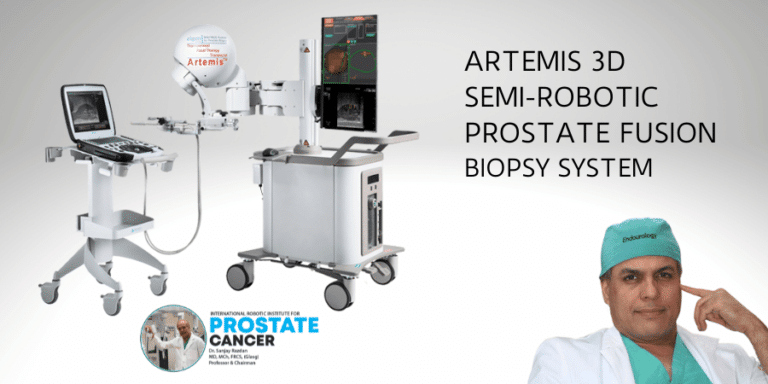
OK I kind of understand the reason that these machines are colored 2001: A Space Odyssey white. If they were black, like Star Wars probes, I would have freaked out.
After I got the 12 inch 22 gauge needle of pain killer directly into the prostate, the doctor started piloting around up into my lower intestine until everything was in focus. I was curled up into a semi-fetal position on my left side with my butt hanging out and my feet gripping a pole. Vulnerable? Yeah. I could see the big screen on the wall in front of me but couldn’t recognize much of anything of my insides. He called out a few landmarks including my half-empty bladder. Then he started marking the outline of my prostate with a kind of primitive version of Photoshop filling in the lines of the waypoints he made with about a dozen clicks. I could tell the compute was kind of old considering how slow it closed the lines, but I had other concerns.
You really don’t know what kind of pain you can handle. At least I don’t. But I could tell when it comes to the kind of plumbing the doctor was doing, he wasn’t wasting time being gentle. He had business to attend to and he was all up in my business.
The Scary Part
Here’s where you just might cringe. You have been warned. So the biopsy tool is basically a core sampler. When it is engaged it sounds and feels just like a staple gun. All that wiggling and waggling of the anal apparatus is like wrestling with the occasional push and shove making me readjust my feet on the restraining pole. Then chunk! goes the staple gun and sometimes it’s nothing and sometimes it’s freezes my entire body in sharp twitch of pain. The weird thing is it’s happening in a part of your body that has never experienced that kind of piercing snap. Bang and then it’s over, and then he maneuvers to a different spot and hits you again. I got 18 core samples pulled out of me, basically one every 15 seconds or so. No lingering pain, just the pop. I didn’t know what to expect. But I tell you this, it’s a less sharp pain than when a dental hygienist misses with the cavitator.
Aftermath
I was able to stand up, put on my pants and walk out of the clinic without any problems. I think I surprised my doctor on that score, but while I was on the table I kept cracking up about that old joke about Dan Quayle doing the parachute jump. If you know, you know.
I kind of wished I had driven my wife’s cushy car, because every expansion joint on the 405 southbound found its way to my crotch. Nothing worse than a light football practice, but kind of worn out. Again, it’s just a new place to feel that kind of soreness. It’s like you time traveled after somebody kicked you in the nuts 15 minutes ago. You never feel that initial punishment, but you’re right at that point where you’re walking it off and just now walking normally.
What I didn’t realize was that after the biopsy it would take me about two weeks to be without pain. So while I joked about walking bowlegged on tiptoes, it was the blood in my stool for two days that was kind of dramatic. Very bright red that was. I was doing full doses of Advil for 6 days and sitting down slowly. The only problem after that was getting up in the middle of the night to pee and forgetting to move like an old man at first. I got into the habit wearing loose pants and of sitting down very slowly which I noticed I no longer needed after two weeks.
Active Surveillance
This is the new survivorship.
Active surveillance (AS)—the vigilant deferral of definitive treatment—was proposed in the 1990s as a management strategy for some men with prostate cancer (PCa).1-3 AS was originally intended for men with “insignificant” cancers,2 and selection criteria were stringent.4 However, as long-term safety data have become available, selection criteria have become less restrictive.5,6 The term “insignificant” has largely been replaced by “low and intermediate risk,” and enrollment in AS programs has burgeoned over the past decade.7 Since 1 in 8 American men will be diagnosed with PCa in their lifetime and since with contemporary biopsy, low/intermediate risk is now the PCa most commonly found,8 AS is of increasing importance.
So there is a relatively new status of cancer patient that I’m in. Before I got my results, I had every expectation that I was going to be in one of three categories that I made up for my own peace of mind.
Big C - Something has got to be done soon.
Little C - Maybe something needs to be done one of these days.
No C - Get outta here
Since I got the results of my biopsy this week it turns out to be Little C, and practically speaking I’m in a fairly well-defined category of low to intermediate risk. Once again I had to become familiar with a new set of metrics, those associated with what specialists know when they actually have your core sample cells in custody.
So I had 17 cores submitted to the lab and there is a nice table I have that describes the severity of each sample. 13 of them were No C. Technically those would be:
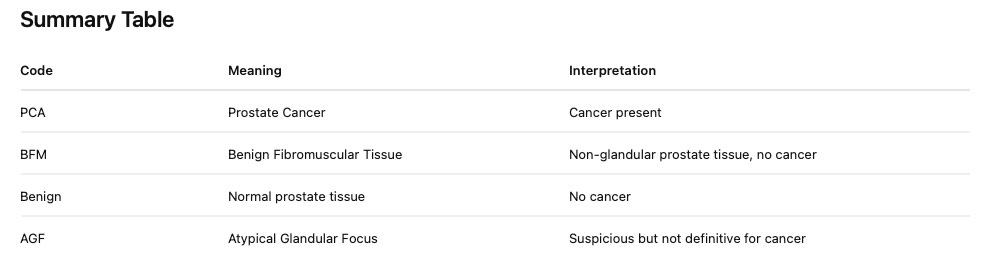
So I have 1x AGF, 3x BFM and 9x Benign
Four of them, on the other hand were definitely cancerous. (4x PCA) There’s a different rating for these called the Gleason Scale, which is more accurate than the PIRADS which is just a picture. Here they look at the cell structure and determine what is likely to happen next based on the shape of the cancer cells.
I have three with a Gleason of (3+3=6) which is the minimum actual cancer and a baddy with a (3+4=7). Pattern 3 means the individual glands are still formed. Pattern 4 means the natural glands are losing their independence and begin to fuse or collapse. The thing to know is that these can can be graded into five groups. 3+3 is group one and 3+4 is group two. (4+3) is group three where more are in pattern 4.
Pattern 3 cancers grow slowly and rarely metastasize.
Pattern 4 cancers have greater potential to grow and spread with more aggressive behavior.
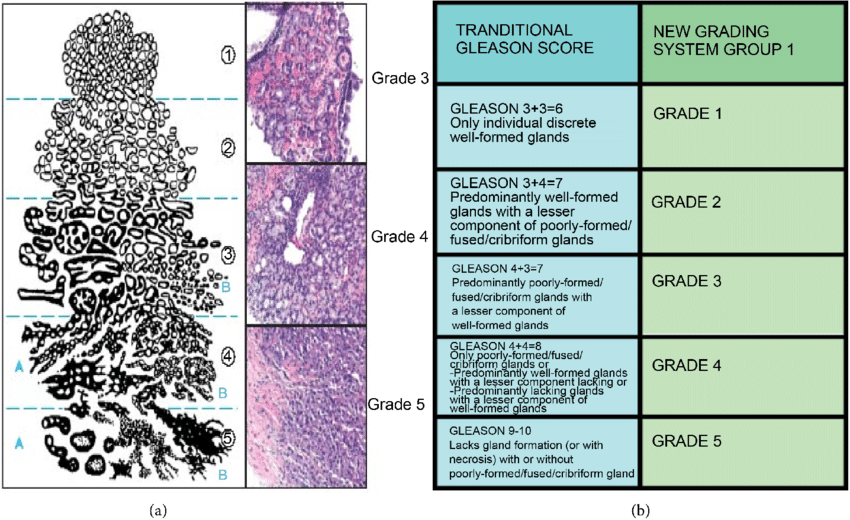
So it looks like we’re in an evolution of the grading system since the new ratings were begun, so far as I can tell from the literature, in 2022. And it is because I am in the group <=2 that I get into Active Surveillance which is almost No C.
What’s Next
The excellent news is that I don’t have to make any decisions until my followup in six months, for a new PSA blood test. It’s fair to say that I have about the minimum and early detected, unlikely to metastasize prostate cancer that it is possible to have according to the latest techniques.
Since my father has it, my son might get it. In the meantime there’s a new genomic classification technique called Decipher Prostate. Surely, the more this diagnostic technique is used, the more it will clarify over-generalized racial characterizations and bring it down to more specific identifiers. Since they have my 17 cores in custody, I’ll get this additional test for free.
So I’ve got these small (all <5mm) tumors in my gonads which are, for the most part, the well-behaved type. I’m a candidate, if it comes to it, for the very specific focal treatment for my nasty bits if they get more nasty than they are. Those can be frozen, lasered, irradiated, chemically injected, sonically blasted or cut out. But since they’re fairly tiny, I think knives would not be indicated. Either way, it’s a great relief to be rid of most of the mystery here.
How Am I Doing?
Well, I’m fine. Thanks for asking. I’ll still have some specific seminal bloody squirts for the next four or five weeks, but biopsies are biopsies. Nobody walks away from that staple gun unscathed. Other than that I’m still a little sensitive and rather amazed I haven’t hurt this way since I was like 25 and used to have an unhealthy amount of sexual activity, like three or four times a day. But on the daily, sitting, peeing, walking, jogging are all normal.
Of course I’m glad I went through all the trouble to find everything out. I’m very confident that I’m going to live through this whole thing with no loss or diminishment of sexual function. I sure as hell don’t want to have to wear a foley catheter or have an entire organ scooped out of my body. So I’m not going to waste time laying sacrifices to Buddha or anything like that. There doesn’t seem to be any supplements of dietary changes that are going to make a difference although I know worse cases than mine have required drugs like Lupron. I haven’t been prescribed anything at all.
So it’s all Little C. Pretty much all good. But I’m being watched. Take advantage of your opportunity for someone who knows more than you to watch your back, or your gonads as the case may be. Survival never stops. Keep your head on a swivel. Take care of your menfolk.
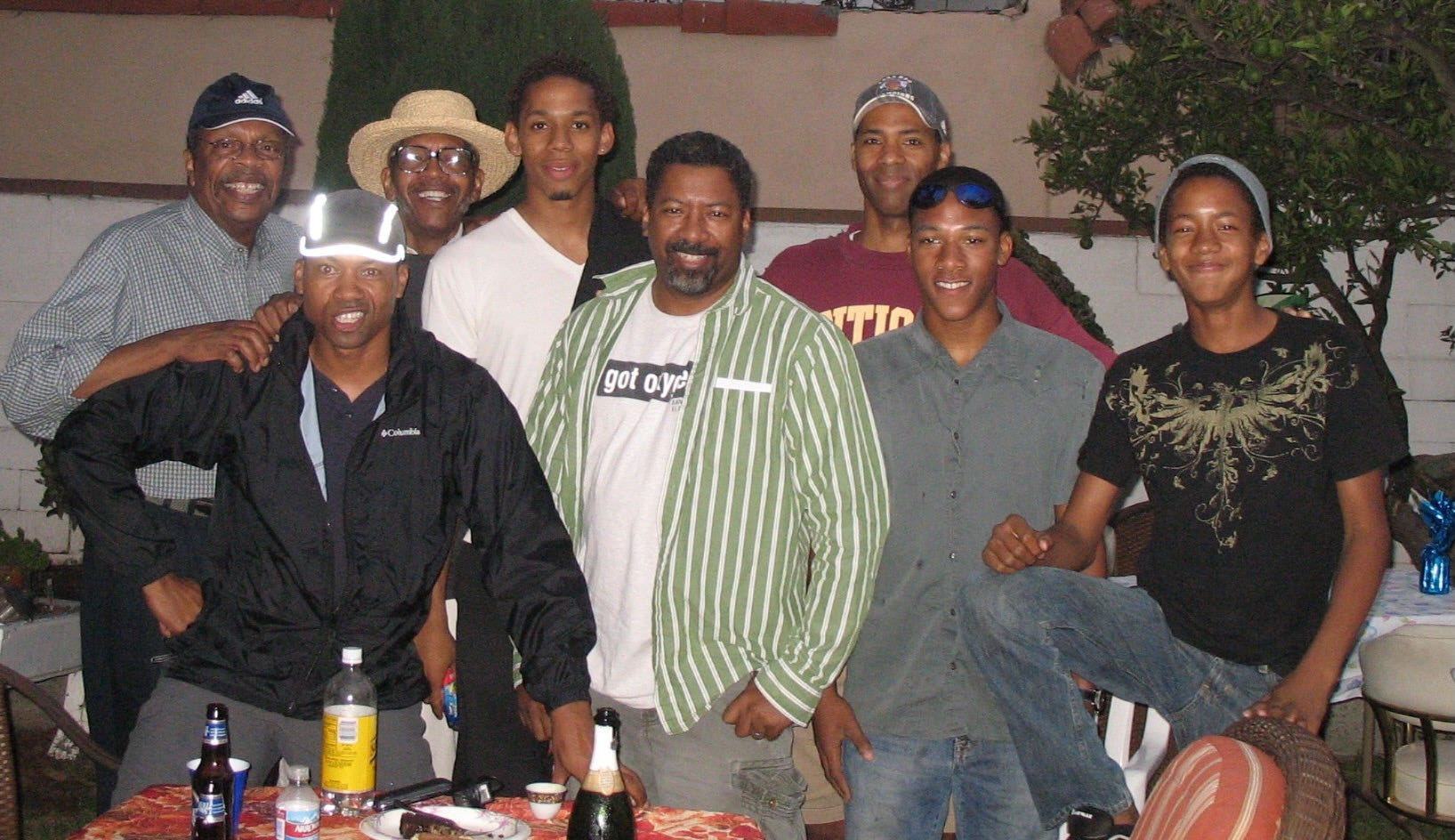
I wish it were no C, but Little is better than Big. Good luck to you on the journey ahead.
Very sorry to hear about the c! I predict that you're going to knock this out. Wishes of health to you!