

Heterodoxy
Pessimism today vs the 1970s


This week I’ll be speaking out at an American reincarnation of the Odd Fellows Club, the Heterodox Academy. Ever since the birth of the Intellectual Dark Web, I’ve been seeking refuge from the philosophical hell of American political partisanship. Fast forward a few, and now I’m on the board of directors for the Foundation for Free Black Thought, which oddly enough, is heterodox. FBT is heterodox because by and large it is made up of individuals whose principles run afoul of the Wokies and Intersectional bullies who have taken over elite college campuses. Not only have the Humanities been trounced, but the Sciences have been beat around the head and face. Those of you who know that there must be something wrong with the cancellation of academic inquiry need no further tutoring.
For those of you who lag behind this cutting edge controversy, the outline is actually rather simple. If you graduated from college in the 80s or before, you are probably aware of the controversy surrounding Affirmative Action. For the sake of brevity, I will suggest that Affirmative Action has indeed drained the reservoir of black and ‘minority’ talent. Today’s ghettoes are more ghetto than they have ever been. If we let the GDP of hiphop be our guide, it doesn’t take much to see that it is a great deal more profitable than it was in the 80s, and an order of magnitude more, how shall we say, depraved? This is part of the inclusion of DEI and… it gets me tired just thinking about it how the spirit of 1960s countercultural politics dominates the themes of black studies on campus.
My presentation is GDI: Black Individualism at Risk in College. The following is the abstract I wrote a few months ago:
Before I was a sophomore in college, I had no idea about the existence of the Alpha Phi Alpha fraternity. Not because my own parents were not college educated, but because they put no pressure on me to conform to any such bourgeois conventions. Like any group, the Alphas and other fraternities and sororities mocked those not associated with their organizations as GDIs, god damned individuals. On a campus that was predominately white, this was a real social factor. I believe in the wider society, black Americans face particular pressures to be 'for the race' and thus put under various obligations not only to put a good face forward in defiance of racial stereotypes, but to participate in various specific institutions which are not neutral or disinterested in race relations. In this way there is always some kind of 'Affirmative Action' assumption placed especially on the heads of black American individuals who are indeed successful. The very existence of Diversity programs of any sort presume a number of things but most subtly that a successful black individual owes a special responsibility to behave as a foil against those black Americans who 'fit the profile' of social dysfunction, etc. Regardless on any black individual's need or desire to fulfill that role, the entirety of inclusion which may or may not use methodologies of tokenism, race norming or quotas, still requires that blacks apply and are accepted as blacks or as people of color, a term of dubious value. So the question arises. What choice does a black individual have to be considered individual in his vector? The author will consider various unusual ambitions and ask, Am I Individual? More importantly, what can a college undergraduate expect?
But since I only have 20 minutes to speak, I’ve simplified all of that into some memes I hope to be propagated. The simple one is to understand how many black organizations there are on campus. In the mid 80s, for me on a campus of about 27k students with about 1,750 black students, we had 23 black clubs and organizations. I’d say that represented a healthy diversity of black interests. My nickel says the diversity of black orgs, fraternities and sororities has decreased and are now served by an ideologically narrow oligopoly of a few. One can hardly blame students for this.
My own story was sweet and simple. I enjoyed exactly how many flavors of black I desired, but was completely disabused of any notions of black power arising from racial unity. It became obvious to me that black Americans of my generation would not be corralled. If that were still the case today, it would be difficult for me to see any case being made such as Lukianoff and Fryer have made about the state of education in America. What’s at stake in my interest at Free Black Thought is the extent to which individualism is at risk when race informs education in ways such as I describe here. (See especially the large whiteness graphic).

Hunkering Down?
It is sad and pathetic that so many Americans cannot get over their stupidity around race and identity. What is one to do? Hunker down with your Oddfellow travelers. As a Stoic, I’m prepared to live monastically, which is an odd thing considering the robust strengths of the American infrastructure, open society and free market. But it is true that millions are self-segregating and engaging in culture wars that are both tiresome and chronic. I am putting in my good faith nickels and dimes, and I’d rather fight than switch, but I’m getting too old for this shit. The irony is that the older and wiser I get, the more my heart bleeds for the utter duplicity and confusion that keeps so many dizzily spinning in place.
But that’s just the racial end of it. What is more deeply at stake is the fact that I see here in America a clash of civilizations. I suspect that we are ill-prepared to do anything but draconic whiplashing as our cultures of complaint ratchet up their activism into law. I’m trying to get a handle on that, but honestly, I have always found it to be the case that Americans can buy their way out of public trauma.
The motto of the Odd Fellows is “Friendship, Love & Truth”. What could possibly go wrong with that? At some point in my frail future, I will have to be ensconced away from mindlessness in the streets, but today is far from that day. What I worry about is not so much the stridency of militants, so much as the complacency of the affluent. The more time I spend working hard to make seven figures, the less time I have to keep up with the coherent worldview I get from disciplined reading. Consequently, the more defensive I become. Part of me relishes being old, cranky and rich - I want to be like George Carlin in his last days. But then George was no longer funny. Just like Russell Brand is not funny and the humor of shows like Last Week Tonight, is just annoying and cynical. Friendship, Love and Truth seem the furthest from any of those hosts minds and capabilities.
Unfrosted
Exceptionally, there is Jerry Seinfeld, whose latest foray is brilliant and funny. It harkens back to films like Mad Mad Mad World.
I have been for some time, as a GenX individual, worked to be Stoically dismissive of our first world problems, which includes the grade inflation and degradation of education of affluent families at elite staff-heavy universities. It’s rather cliche to say that we’ll always be saved by immigrants, but there’s an adequate amount of truth in the fact that people who are unsociable enough to go to dental school are part of America’s professional backbone. Who cares if our tax attorney couples stare at each other’s foreign born feet? We need fervent and sustainable belief in the American dream. It has been several years since upscale crowds cheered to Hamilton’s line “Immigrants, we get the job done.”, but that was a national sensation.
All this to say that I’ve been looking backwards to the 1970s when Americans truly believed that our society was doomed. So four films come to mind, and I’ll probably be consuming a few more in the weeks to come. I’m testing whether or not my heterodoxy today is nothing more or less than the orthodoxy of yesteryear. So far, I’m surprised.
Dirty Harry (1971). I never watched this movie. Everybody has seen the ‘feel luck punk’ scene. It comes early enough in the film where we’re trying to figure out how Harry got his nickname. Overall, I’d say it’s a good look at how we began to look at the fallout, in terms of moral ripping of the conventions of society, that the death and purposelessness of the Vietnam War inflicted on young men.
Soylent Green (1973). This movie made me cry. I swear to god I didn’t expect it, but the sheer hopelessness depicted in this vision of 2022 was filled with pathos. I had Friends of the Earth branded notebooks back during that year, and although I never read Silent Spring, the perception that the Earth was doomed to overpopulation, pollution and corporate corruption was thick in society. We didn’t have to travel far to see the ugly city. When I saw the old LA Sports Arena, that’s when it really hit home.
The Omega Man (1971). I’ve watched this film many times. It was the first grown up movie I ever saw. It’s also dark, and brought echoes of revolution and world destruction into the fore. What do you know, Charlton Heston again.
Kelly’s Heroes (1970). Here’s one for a bit of nostalgia with an ensemble cast. This is something finally that Seinfeld has revived, but only for comedy’s sake. I can’t imagine an ensemble cast assembled for a war movie with ‘heroes’ in the title. I suppose The Monuments Men filled that bill ten years ago, but it never appealed to me. Recently, appropos commentary on Gaza, it has been said that Americans no longer think of war in terms of victory and defeat. So we do not grasp what is at stake and thus cannot formulate a policy or a politics that can deliver victory. This one has a kind of rebel patriotism, anti-heroic ragtag theme. It’s really good for that kind of tension and the confidence in sharp decision-making we expected under life and death situations.
I’m also going to take another look at the original Planet of the Apes, some other feral motorcycle flicks and dark disaster movies that characterized the pessimism of the 1970s America. Do you have any suggestions?
Pessimism today is manifest in the reinscribing of historical ills in racial and ethnic terms. This is the racialized teaching of youth in the institutionalized Struggle that dominates American Studies curricula. The invention of ‘people of color’ needs a white enemy to make everything racially institutionalized. So naturally one fights institutional fire with institutional fire. So the Woke are bankrolled, not ironically with ‘white’ capital. The DEI recipients sanctify the gift. That’s part of the ritual.
I know my own father had a correspondence with Ralph Bunche, and James Comer and a many more I will try to find time to discover as I go through his papers. But I do indeed wonder if Bunche would find the work going on in his name at UCLA appropriate to his legacy. I honestly don’t know.
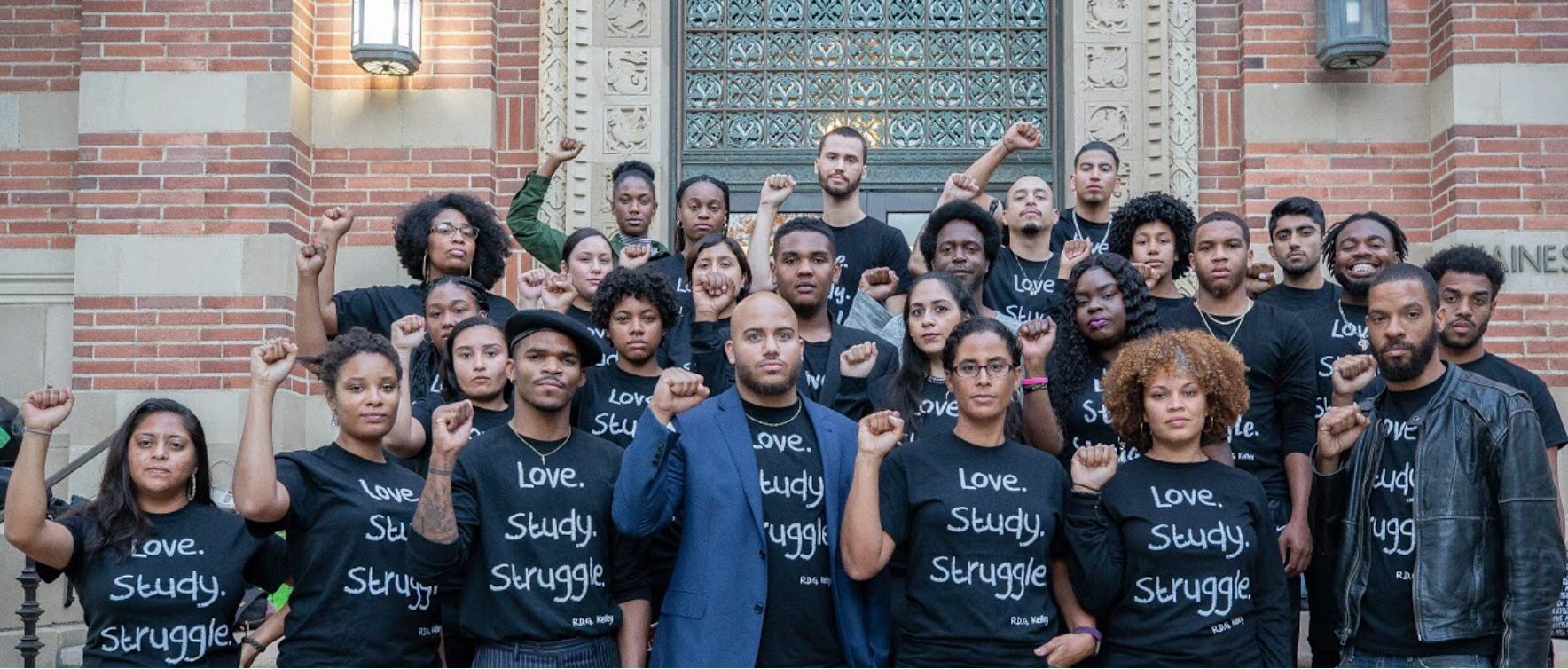
Still I think that in a postmodern world, this kind of dissonance can be expected and the truth of certain experiences farmed and funded. This is part of our freedom, but can it stand up to interrogation and criticism? If the very act of declaring heterodoxy is in question, then we’re in trouble. I say look to the heart. I leave you with this slide from my upcoming presentation.

Some suggestions to consider for related movies:
https://en.wikipedia.org/wiki/The_Year_of_the_Sex_Olympics
I was unable to locate this highly regarded dystopian teleplay when I first heard about it, but it's available for streaming on Amazon (your piece inspired me to check its current availability, so I plan on watching it soon). From 1968, but definitely foreshadowing the 1970s zeitgeist.
Speaking of pre-1970's, make sure your survey of biker movies includes The Wild Angels, as it pretty much invented the post-Wild One genre.
Black Angels (1970, aka Black Angels From Hell) is a ridiculously cheap (lots of footage several times) film of the sort that most people find painful to watch (so I'm not sure how highly I recommend it), but the Armageddon between white and black motorcycle gangs is obviously cautionary (hearkening back to the fuel depot shoot out between Harry Belafonte and Robert Ryan in 1959's Odds Against Tomorrow). The big twist is that the overtly racist Southern biker who infiltrates the white gang turns out to be a passing mole for the black gang. As I recall, the violence between the gangs is largely promoted by The Man manipulating the gangs.
Also (still not from the 70s, though) the Aussie-Brit production Threads is a thoroughly dispiriting depiction of society falling apart post-Nuclear War.