

Palestinian Nationalism
Some geopolitical context.

Several weeks ago I started to write an essay about nationalism. My aim was to compare America’s history of Black Nationalism with the Middle East’s history of Palestinian Nationalism. I had two rather provocative sentences that I will repeat here.
I know what it feels like to need a nation.
Free speech begins with ‘fuck you’.
I then proceeded to talk about my participation in my parents’ pioneering aspects of Black Nationalism and Pan-Africanism which began in the mid 60s and ended abruptly in the mid 70s. When I elaborated on all of this and attempted to compare it with Palestinian nationalism, the whole edifice crumbled and all I had left was my own stunned silence, deepened historical context and a couple provocative sentences.
So instead of a dozen paragraphs from which one might compare and contrast, let me simply show you why the two are not comparable, revealing my biases and a few geopolitical contexts that I’ve never heard anyone discuss, and a lot of shite that is kind of like discussion of the salt and pepper and not the fried egg. So let’s engage in some discovery, shall we? But first let me editorialize.
Stupid American Politics
I was over 40 years old when I first read a book about Stalin’s crimes. For some idiot reason, I never bothered reading Solzhenitsyn. Nor had I heard of Robert Conquest or Arthur Koestler. Well, part of the idiot reason was that I had been convinced that the American Conservative obsession with anti-communism was a mere pretense for war-hawkery. I actually have written somewhere that racism in America was worse than communism anywhere else. While I have never been an apologist for the godless commies, I didn’t realize how many people they starved to death for their ideological aims. Reading those three authors cleared out that fog with alacrity. My only excuse had been “Well I studied Computer Science, not Political Science.” Fortunately, I did enjoy Morning in America under Reagan and I wasn’t completely put off by Republicans. So I wised up.
In that same way that so many Americans don’t concretely realize that D-Day at Normandy was not the pivotal battle in WW2, and that the total participation of American forces in Europe was but a shadow of the investment of the Germans and Russians against each other on the Eastern Front, there are some dramatically shocking secrets in geopolitics we haven’t learned. We’re missing a lot of common sense. Speaking for myself, I think I was typical when it came to any solid understanding of what China was doing in WW2 and immediately after. Somewhere in a fog of names like Chou En Lai and Mao Tse Tung and Chiang Kai-shek the answer was “something we Americans didn’t have to pay attention to”.
So that’s where we have to start with Palestinian Nationalism, on something very few people talk about and doesn’t really enter into our postmodern politics. I’m sorry if I may insult your intelligence, but I can only presume that you were as ignorantly indifferent as I was.
Fall of the Ottomans
WTF was the Ottoman Empire and what does it have to do with the Middle East? If you don’t know, which I don’t know, you’re stuck with dealing with all Arab Nationalisms as if it arose out of the context of European Imperialism. That’s your first huge mistake and it introduces us to the simple context of WW1.
Why does anyone bother to talk about the British Mandate as a textbook colonial abuse? Because it’s almost impossible to imagine that what this conversation is all about.
Indeed Arabia was tribal and quarrelsome. But after the fall of the Ottomans who had dominated this region of the world, much was up for grabs. So we must talk about Faisal and Abdullah, brothers of Hashemite origin who had the loyalties of men like the man portrayed by Omar Sharif. And certainly there were British as portrayed in the film, but there were French as well. The bottom line is that the Ottomans lost.
Prior to Arafat
The most significant Arabs whose missions and movements shaped Palestinian Nationalism are:
Hajj Amin al-Husseini
Raghib al-Nashashibi
Sharif Hussein bin Ali
Prince Faisal
Prince Abdullah
Here’s what’s new in my understanding as a result of my extended conversation with Grok, and later with ChatGPT. Firstly, I have to say that a lot of it was prompted by this Munk Debate with a woman named Natasha Hausdorff. You can look at this video to get an idea of the beginning of my recent learning.
It is salt or pepper on the egg to get bogged down in whether one can or should characterize all anti-Zionism as anti-semitism. I would stipulate it for the sake of such a debate, but that’s not my aim here. It is to situate the pitiable situation of the remaining stateless Arab nationalists (aka The Palestinians) with regard to the geopolitical evolution of Arab Nationalism itself. The Arab League was established in 1945 and now consists of 22 member states representing 481 million people. My questions and investigation boiled down to the mystery of how those millions got their statehood and evolution out tribalism and the rest got stuck with the likes of HAMAS.
What really struck me was her argument that Palestinian Nationalism was essentially started by Yasser Arafat in 1948, while most Arabs that now call themselves Palestinians were citizens with passports issued by Jordan. What I discovered was that there were two phases of Palestinian nationalism, the first phase which was led by Hajj Amin al-Husseini, who was around during WW1 and had a fledgling military movement somewhat analogous to that of T.E. Lawrence during the Arab Revolt. That made me consider Lawrence’s problems on both sides to overcome the reality of Arab tribalism. The history shows that al-Husseini, most definitely predates all of the political groups and must be said to be the father of Palestinian nationalism, but he only won one battle and his militant movement fell apart.
The Imperial Shuffle
It’s easy to understand the short shrift inherent in the hope sustained by Arab nationalists considering how the Balfour Declaration stated nice things in theory as contrasted to the reality of the situation on the ground. So whatever aggravations and complaints the new nationalists had, well they weren’t alone. Nevertheless the unifying Arab sentiment was not so much motivated for a particular homeland beyond the river to the sea, as it was for the denial of the Zionists to get theirs first (or at all). Why should they get and we not get? I get that. But I don’t automatically grant the hope for nationhood any moral high ground.
In comes King Abdullah, leader of the Hashemites in Jordan, who basically didn’t give two shits for al-Husseini and his cause because of three primary reasons. First and foremost, al-Husseini was an officer for the Ottomans in WW1, and during that conflict Abdullah threw in with the Brits after 1915. In fact his brother Fasial and he actually did fight with Lawrence. Secondly, Abdullah had his own land-grab planned for ‘Greater Syria’. Again, another rival nationalist plan that did not quite work out. But still Faisal was running Syria until 1920. For a short time, he had al-Husseini’s support. Abdullah kept making clever moves during the time of the King-Crane Commission. Ultimately Abdullah was granted the TransJordan in 1921, but by that time his brother Faisal was kicked out of Syria by the French.
Brittanica notes:
King–Crane Commission, commission appointed at the request of U.S. President Woodrow Wilson during the Paris Peace Conference of 1919 to determine the attitudes of the inhabitants of Syria and Palestine toward the post-World War I settlement of their territories. The commission, formed when attempts at creating an Anglo-French group failed, was headed by Oberlin (Ohio) College president Henry C. King and Chicago businessman Charles R. Crane. Touring Syria and Palestine between June 10 and July 21, 1919, and soliciting petitions from local inhabitants, the commission found that a vast majority of Arabs favoured an independent Syria, free of any French mandate, and that, of about 1,875 petitions received, 72 percent were hostile to the Zionist plan for a Jewish national home in Palestine. Such findings, coupled with Zionist talk of dispossession of the Arabs, led the commission to advise a serious modification of the Zionist immigration program in Palestine.
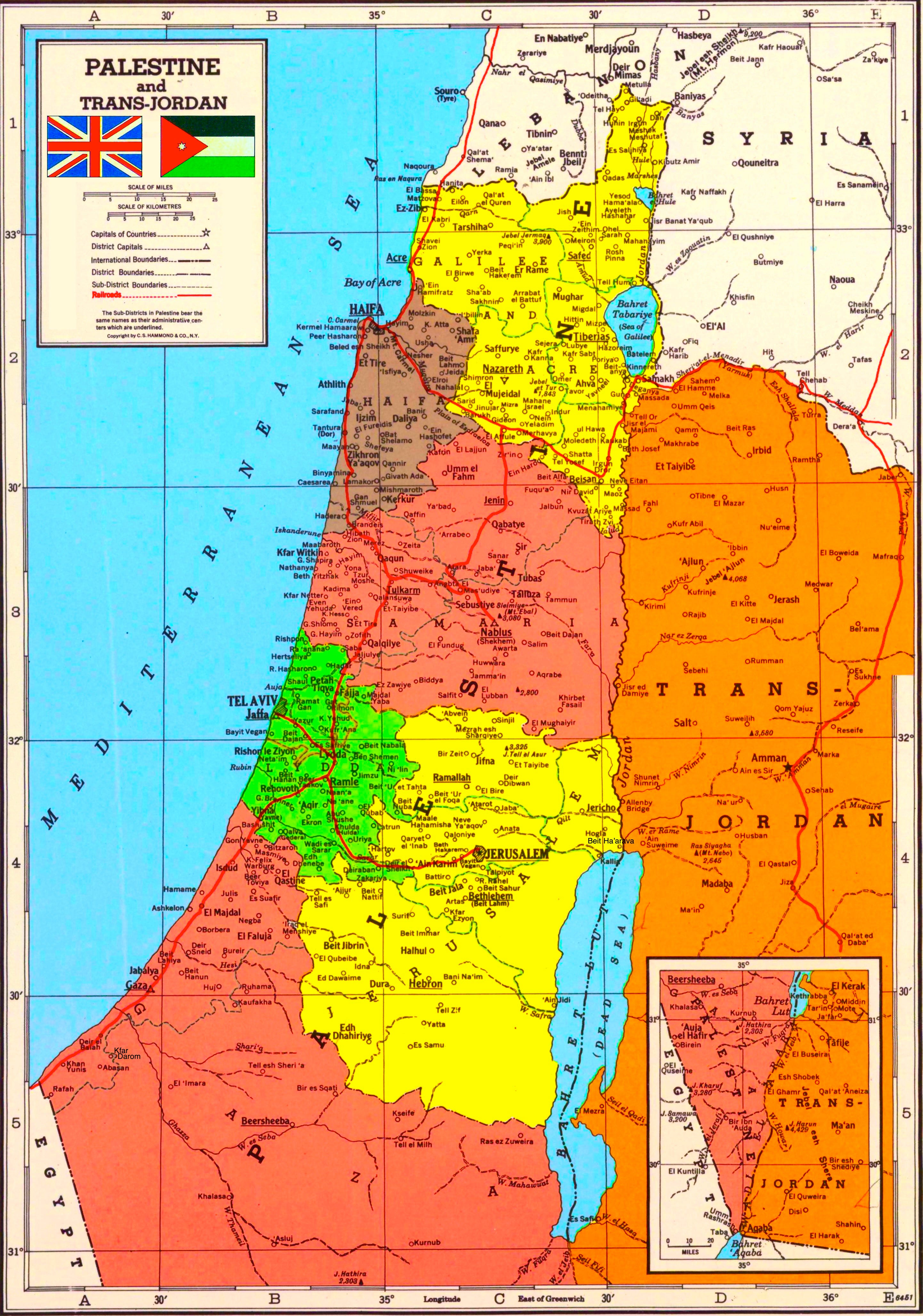
In the meantime, al-Husseini continued to squabble with Raghib al-Nashashibi, also a prominent Palestinian nationalist leader. Al-Husseini was the closest to what we would call an Islamist. On the other hand, Raghib al-Nashashibi was more amenable to working pragmatically with the British. Given what Abdullah got from the British (The TransJordan), who would you bet on? As you might suppose, al-Husseini the new head of the Supreme Muslim Council went hard against al-Nashashibi, the secular negotiator and head of the National Defense Party.
In 1936 through 1939, al-Husseini’s camp won the upper hand during the Arab Revolt. Here’s when they really solidified their Anti-Zionist positions. Once again, the British cracked down and exiled al-Husseini to Lebanon and then he fled to Iraq. So he decides he’s done with the Brits and becomes a Nazi sympathizer. By the end of WW2, Faisal got Iraq, Abdullah gets TransJordan, the rest get nothing. Why? Because the al-Husseini faction is tainted by being too close to the Nazis and the Nashashibi faction is tainted by being too close to the Brits.
Between ‘47 and ‘50 Israel is granted a border by the UN, splitting the TransJordan into Jordan and Israel. The non-Hashmite Arabs who couldn’t decide between al-Husseini and al-Nashashibi made for a fairly disorganized fighting force and a marginalized political force. When everybody else was fighting against Israel, Adbullah, perhaps still thinking about ‘Greater Syria’ takes his disciplined fighting force, The Arab Legion, and captures East Jerusalem and the West Bank. Surprise, Jordan recognizes Israel. Now you have war refugees without an army, without a country and without many political friends. These are the people we call the Palestinians and their dispersal after the attempted gangbang of Israel is called the Nakba. So they flee to Jordan, Lebanon, Syria and Egypt’s Gaza. Egypt has done the Palestinians no favors whatsoever. They are the original military occupiers of Gaza.
Meanwhile, the militarily successful Abdullah occupies the West Bank and naturalizes all of the Arabs there as Jordanian citizens. In 1951, he is assassinated by one of the Palestinian nationalists while at prayer in the Al-Aqsa Mosque. His 21-year-old killer Mustafa Shukri Ashu, a Palestinian nationalist, is immediately shot dead by bodyguards. Damn. Perhaps the ugliest way to claim a nation is to try for a coup.
Israel wins the West Bank back in 1967. So the Palestinians are left with the Gaza Strip and the West Bank, hardly a nation. So it is not entirely unreasonable that they have plenty of reasons for saying ‘fuck you’. The problem was that they said that to Britain. They said it to the Hashemites. The two factions said it to each other. They said it to this Israelis, the Zionists, the UN, same way they did back in 1919. So finally by the time they said it to the Egyptians running Gaza, nobody cared. Ahh but when they said it with a bullet to the brain of Abdullah, I think they figured that this was the way forward. So there is the difference. A war dispossessed them, perhaps only a war will finally get them what they want. They’ve made a lot of powerful enemies along the way. But they’ve also made friends who have ‘fuck you’ on their minds as well - such as left activists in Europe and North America, and organizations like the Muslim Brotherhood and various satraps of Iran. The enemies of your enemies make for fair-weather friends, but not national allies, especially when you don’t have a nation.
The Fried Egg
So the salt and pepper here is anti-zionism, anti-semitism and all the tribalisms in post-imperial Arabia. The fried egg here is that al-Husseini stuck with the Ottomans, and they lost in WW1. He stuck with the Axis, and they lost in WW2. Abdullah was crafty and cut a deal with the Brits and with Golda Meir. He got Jordan and the West Bank and granted Jordanian citizenship to nationalist Arabs. For that he got a bullet in the head by the the radical militant Palestinian nationalists.
So what I’m left with is a small set of Arabs who failed over several decades to establish themselves as a nation, while many others managed to do so. It’s more than simply bad luck and mismanagement, but a fierce militant determination to attempt to play a Game of Thrones without the power or cunning to make the kind of geopolitical moves of those who successfully negotiated statehood for other Arab populations in the area.
It’s difficult for me to ignore the partisanship of the Palestinian nationalists that got them on the wrong side of the various political organizations said to represent them through the years. I say so with a complete indifference to the moral claims of nationalism itself. To me, any desire for Arab nationalism is equally legitimate to the desire for Jewish nationalism (aka Zionism) or Black Nationalism. But it is the prosecution of the process that makes all of the difference, and that inherently requires serious diplomacy, control of militancy and reasonable peacetime politics.
It is for these reasons that the ways and means of American Black Nationalism is incomparable to those of Arabian Palestinian Nationalism. The histories, motivations and actions are far too divergent. We here in the States got out of our ‘fuck you’ phase in short order despite the fact that we felt the need for a nation. In the end, we were satisfied with the law of the land, and a bit of cultural unity, myth-making and symbolism. But I suppose I can only speak for my own family.
If you have the patience to go there, here is a standalone context.
Notions of Nationhood

My father asked me the other day what I thought about nationhood. Even in his current fog there must certainly be deep stirrings surrounding the term. He was an original American Black Nationalist, having founded the small Institute for Black Studies in late 1966. It can…
Excellent essay.
Some thoughts.
Although 40 is very late to learn that the communists keep power only through slaughter and oppression, are an extreme danger, & are every bit as bad as the Nazis. some people never learn that at all.
War is a racket, so I understand short handing anti-communism into an excuse for the military-industrial complex.
The problem, of course, is that war is sometimes necessary, & keeping communist powers in check requires a good deal of blood and treasure.
Wonderful background on which Arab nationalists were successful following the dissolution of the Ottoman Empire, & which were not.
I'm a little surprised you didn't mention Black September specifically, but the 1951 assassination serves for the tone of Palestinian -Jordanian relations.
Palestinians living in the Gaza Strip, having emulated the Nazi's in what they did in Lidice, Oradour-sur-Glane, & countless other towns, have earned the same sympathy & understanding given to the Nazis.
They can either accept Israel's existence, or they can suffer the same fate as the Tamils.
They have legitimate grievances. If they choose to continue to try & resolve those grievances through war, they will be met with more war, & they will lose.
Good stuff.
Thank you. I will share this with my Jewish friends who voted for Mamdani.