

Six Seven
What it really means.

Long ago, I escaped what for me was the boredom of being Buppie. For the years that I had worked in a union retail warehouse and as a bank teller, I was missing the college education that simply cost more than my family could afford. So when I prepared to work my way through State and the term Yuppie came into fashion, I knew that’s what I wanted to be, only black. So those were the friends I selected and corporate America was my destination. That infatuation lasted about seven years until I finally tired of dancing in suits.
A turning point in my life came upon reading Toni Morrison’s Beloved. Suddenly I felt that there was an intellectual life that had rhythm and rhyme, depth, substance and international resonance. I had to be there. I started reworking myself, without guidance, with no particular goal in mind but to be free of my prior constraints. To orient my mind towards higher pursuits than material security, which I actually needed but de-emphasized. I had reached the level of survival and even comfort I never had before. “We didn’t know how poor we were.” Yeah. I was the kind of kid who built his own BMX bike, $10 at a time.
In all of literature, I had nothing in common with anyone in particular. There was the character of Woody Allen’s thirsty schlep, but I could do push ups. There was the character of Bigger Thomas, but I could do calculus. There was Starman Jones, but I wasn’t sullen. There was the character of Ellison’s boxing yokel, and Toomer’s Kabnis. Nobody quite fit. So I was a work in progress, a man out of time and place. But then I remembered Sixo.
Sixo, a secondary but powerful character in Toni Morrison’s Beloved, is one of the most striking figures in the novel’s flashbacks. Though he doesn’t appear often, his presence is memorable and deeply symbolic, representing resistance, ancestral strength, and a kind of unbreakable freedom of spirit.
In short, Sixo is a warrior-spirit—mysterious, powerful, and irreducible. He doesn’t just survive within slavery’s system—he transcends it, reminding both the characters and the reader that even in the bleakest circumstances, freedom can live inside a person.
Like Sixo, I found my Thirty-Mile Woman. Unlike Sixo I wasn’t burned alive before my son “Seven-O” was born. But like most black Americans of my ilk, I carried a tragi-comic sort of symbolic existential connection to themes of slavery, freedom and underemployment. So around the time of invention of MyYahoo, I picked the pseudonym of sixo61@yahoo.com. That account still works. And five years after that, I picked the gamertag of “sixoseven” on XBox Live because I considered myself further than Sixo yet unaware of what Seven-O might be. It’s still a pseud I use.
Doot Doot
This morning I happened on the following genius video. I’ll say it’s definitive.
I don’t know Doot Doot and I don’t know Skrilla. And even if you read all these lyrics, you won’t know it or him either. Dr. Taylor Jones does what a scholar on the ball does, he doesn’t take shortcuts and just says something stereotypically racial like “It’s a black thing, you can’t understand.” He explains the social dissonance six ways before Sunday.
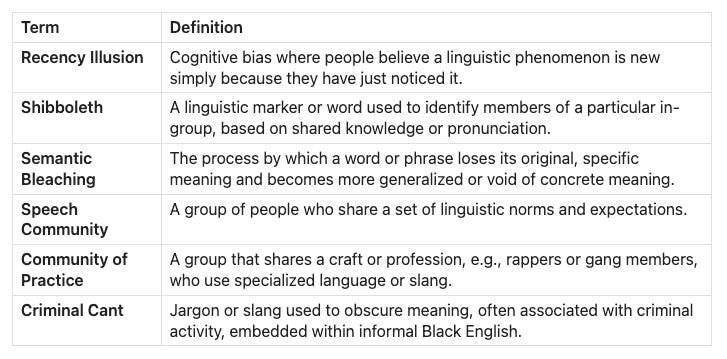
What’s new to me is the concept of Criminal Cant. I think it can be applied to a great deal of political speech. But my bottom line can be taken from this.
And if you just credulously believe that Google will have an accurate result for slang people use in other cities and don’t, you know, put on websites that rank well, then you might even think that you can just Google 67 or 67 and bip and get a meaningful answer. And when you do, you’ll get all sorts of nonsense.
BIP is everything from Bloods In Peace to a smash and grab in Oakland to a haircut in Baltimore. So SP Nation reports that 67 is largely accepted to be a reference to 67th Street in Chicago, which has a reputation inside the city for being dangerous. This is a weak contorted explanation that misses that Skrilla isn’t from Chicago. I mean, hell, the music video for Dudes in Philly after the Big Eagles win. But people, in this case, James Detor, can just say stuff and it gets taken as a credible explanation because it’s in print.
…
So, you’ve got a Philadelphia rapper using Philadelphia slang and Philadelphia police codes [10-67: Report of Death] in his music video shot during Philadelphia’s celebration of Philadelphia’s victory in the Super Bowl. And somehow people say, “He’s black. This must be about Chicago.” And as soon as the line is repurposed because somebody made a clever connection between a lyric and a different reference, it spread like wildfire, divorced from its original context.
Human in the Middle
We clearly need expert opinion and context in the middle of the semantically incoherent echo chamber that is social media on the interwebz. And it’s purposefully ironic that I have found this expert and decided to write about it in the context of growing intellectual muscles outside of formal education to talk about whatever the right category is for ‘6 7’. It’s social dissonance for me, a term I’ve been using for a long time. And it’s a deeper look at code switching which is a kind of semi-weaponized passive-aggressive defense of Ebonics. Since we have been processing the idea of Black Fatigue without this kind of context what needs updating are these ways and means of expressing English in America.
This becomes more subtilely interesting when we consider the interpretive power of LLMs over search engines, and the extent to which they both use some of the same code. I don’t think either of them provide a good substitute for what YouTube gives us and what curators like me can relate to all of you.
By the way, I was just in New Orleans for a week and although I can do a passable accent, because my mother’s side is from there, I don’t know the places and the local terminology. There are only a few things that I can still remember from my childhood when my mother would find country cousins out this way in LA. So I still know
Gris Gris - a minor magical curse for altering the course of pool balls, etc.
Pa Coh Nay - “I don’t know.”
Linguistically that’s all I can remember, but I do know what a good bowl of red beans and rice is supposed to taste like and I don’t like chicken in my gumbo. That’s just cheap.
Ahem, The Point?
Well some of you have already guessed that I’m going to double down on mammalian intelligence as something superior to semantic coherence, even as much as I’m a literature and jazz snob. But also I want you to consider how often so many of us get caught in our experiential bubbles and take simple explanations for granted. We’re always going to need scholars. I still haven’t finished Pinker’s book on common knowledge and I don’t know how far he aims to take his brilliant observations with regard to how many of us can know what we suspect all of us know — because indeed we are always modeling what we think other people are thinking. Just as we think kids today are skibidi Ohio, but even that term has jumped the shark. No, not the Left Shark.
We are kind of doomed if we believe we are transcending by just being augmented. I think we’re coming to recognize the limits of these proxies for intelligence. The very fact that propaganda still works and that people down the street speak a different language with a different context proves that we’re not going to level any playing fields permanently.
As a final note, I’m going to ask you this time to like and restack. That gets our little tribe a bit more exposure. Six Seven can mean so little, so differently to so many people and even my earlier self identified out of time and place. We all need each other. Group hug.