

Social Entropy
A new dimension of the Peasant Theory.


For probably more than a decade, I have been thinking about society in terms of three functional classes, Rulers, Geniuses and Peasants. That originated in my observation that “the broad American middle class” operated in a particular way with respect to power. We believe that it has more than it does and we misjudge the way its power actually works. There are also two other concerns that I have with regard to the ability of the Peasant class to exploit democratic institutions towards their advantage and since I have seen them in the context of us largely being peasants, I recognize the walls we hit.
Wall One: Self-Selection
It was relatively easy for me to discount the essentialism of race as an individual. Even as a self-selected member of a ‘sub-culture’. So there is a matter of discipline, like self-expression of a particular aesthetic flavor or self-censorship of particular taboo speech or self-study of political partisanship that keep me in an identifiable place. As an individual I myself paint myself into a particular corner, and so identify myself with that corner and reify & reinscribe myself into that demographic. This works because I place constant attention to my identity and my aspirational corner of society, and I make constant efforts to signify that I belong into that corner. I press myself into those walls.
This is consistent for all mutable possibilities of ideas it is possible for me to hold, and all probabilities of places in society I am able to go. The matter of self-selection is your degree of freedom within the functional and power structures of the three classes. What kind of Ruler do you want to be? What manner of Genius are you desirous of expressing? What shape of Peasant are you? Call these your personal ethics. You doing you. Your particular vibe, style etc. You’re still bound by the functional relation to power, but you have some mobility.
Wall Two: Social Capital
I may borrow incorrectly from Glenn Loury on this, but apart from your own self-discipline to become or remain your aspirational person, society itself bestows or denies you agency which is beyond your control. That is to say, no matter what you look like, think like, study or attempt, society has some institutional passageways that you move through with the wind behind you or blowing against you. You are not in control of that weather. To extend the metaphor it is the will of Rulers and the implementations of Genius work that open or close that Overton Window of how much and which way the wind blows. The climate is the nation’s economy and political system, neither of which are relatively volatile.
We can pretend that our meritocracy is efficient. We can pretend that our religious discipline is moral. We can pretend our justice system is just. We can make all kinds of assumption about what shape we are to be where we want to be, but there are always external factors that determine the profitability of the assets that are you. That varies with time and luck. It’s not random, but it’s stochastic. You can neither fight nor predict the weather. One can only prepare.
Note that these two walls are fundamentally essential to what I think of as the nature of Western Civilization. We get panicked when we see various changes we perceive as threats to the global order and to Western Civilization. It might not be that severe. I think I have a way to explain why.
What’s New: Social Entropy
There are holes in the walls. In the end, there may be more holes than walls. In the meantime, let us count the ways.
I’ve been thinking about entropy lately. Just lightly getting a handle on it, since I’ve been thinking of Claude Shannon and cryptography and order vs chaos. This morning provided a perfect storm of focus and content. I’ve also been thinking about The Overbearing, and been putting some effort into an essay about the possible inevitability of the rise of the Democratic Socialists of America as well as a Nixon-like figure in our future. What I have previously been defending is the desirable primacy of Western Civilization but there are factors that put holes in the walls. The end result, I predict, will be Social Entropy. The video I watched this morning brought a lot of this to mind. No matter how much energy is spent in any direction, in the end things will become more chaotic than in the beginning.
The stunning insight for me was that the Sun sends high-powered low-entropy photons to Earth and the planet reflects low-powered high-entropy photons into space. We consume order and produce chaos. What the fractions are matters, and certainly there are some level of exceptions, but life itself is derivative energy. There will always be more heat than light.
So what if social chaos is inevitable? What if, the more people we have, the less cohesive humanity becomes? It stands as a commonplace understanding that if you want to take over the world (narf) you must expend enormous amounts of coercive energy to restrain and retrain large populations. Conversely, the less energy you spend policing borders and enforcing laws, rules, standards and conventions, the more dissolute your society becomes. And yes of course there are asymmetries and gradients and diffusions in all different directions in random concentrations of power and efficiency. BUT. If you can identify an action in an individual in society and can measure and map the class of individuals to the class of actions, you can ultimately calculate the net entropy of the system. I don’t know how, but I’m interested to learn the terminology.
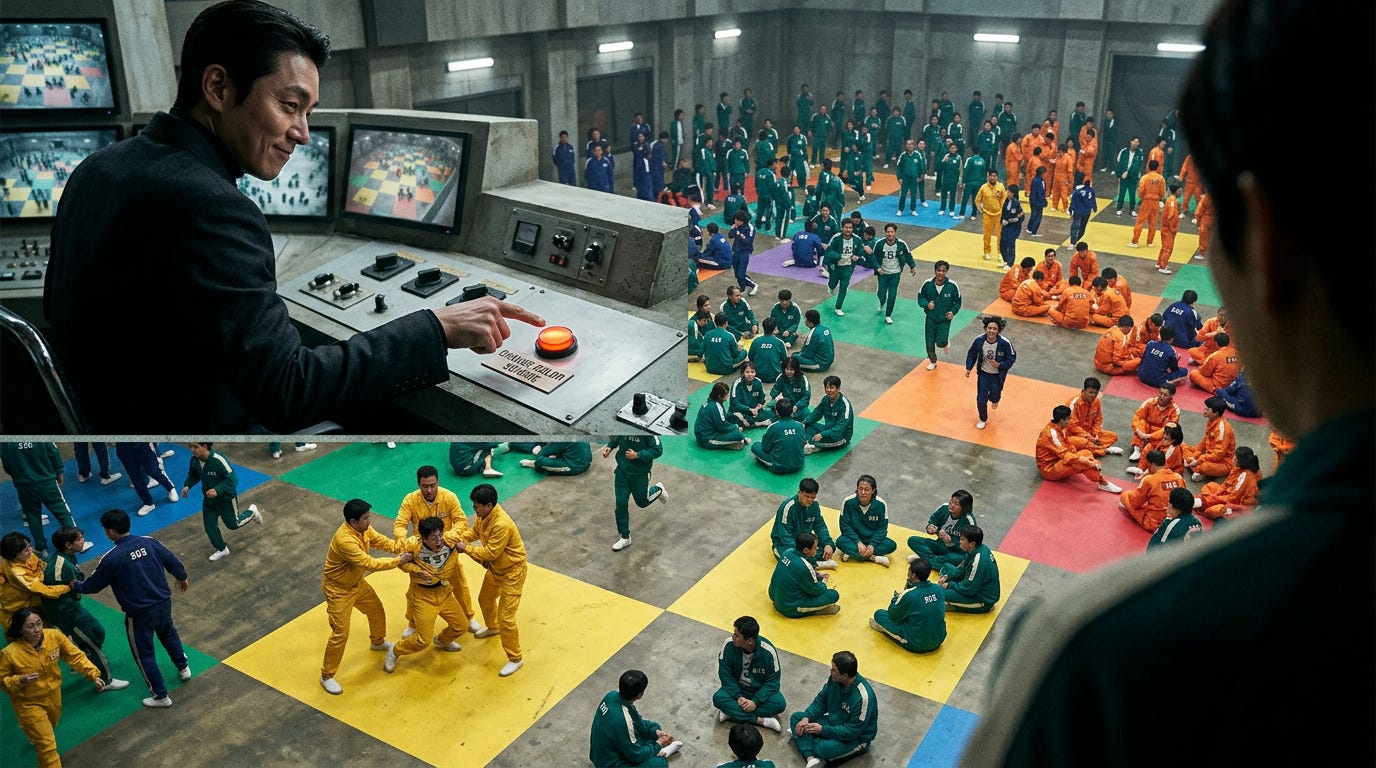
But I don’t want to get all normative here. (Normative is philosophy speak for ‘judgey’). I just want to be qualitative. So let me use a different term, which is less normative than ‘chaotic’. How about ‘diverse’? Ha ha just kidding. But it’s one we have been restrained and retrained to accept. How about plural, or multiplicative? A highly multidimensional society is higher entropy than one which it not. A society that allows free expression in film for example, would have less censorship and allow more ideas to flow. That is a higher entropy society than one with Hays Codes. It is a less predictable society, and I believe it is one that sustains more life.
I say, for the record that I see no contradiction in the idea that a certain amount of creative destruction or destructive creativity for the purpose of a socially multiplicative plurality requires guardrails. There is the paradox of not tolerating intolerance which makes perfect sense to me. Here’s why.
The Tajfel Hole
I am the only person I have ever met that keeps Tajfel in mind. Tajfel is the name of the psychological researcher that proved, back in the 70s that people will cluster around any concept.
Minimal Group Paradigm (1970s)
Tajfel designed a series of experiments to investigate the minimal conditions under which discrimination between groups could occur. He wanted to understand whether mere categorization of people into groups—without any conflict, competition, or meaningful difference—was enough to provoke bias.
Any individual can decide to identify (see Wall One) with any kind of random affinity you can invent. We have certainly been inventive in social psychology, political science, education, marketing and organizational behavior and conflict studies.
The same thing that makes us plastic into groupthink makes us plastic out of groupthink. We can assimilate, tolerate, integrate, educate or appropriate our ways in and out of every sort of human grouping. The sorts are practically infinite, certainly more than we in our minds can calculate or appreciate.
The Stoic Angle
Of course, my stoicism remains through this complication. That’s because I feel capable of adapting, in this American society, through the multifarious manipulations. That is significantly because I have spent enough time around (my estimation of) Geniuses to understand what whipsaws they go through for the favor of Rulers and of facile reorientation within the various Overton Windows we regularly rotate some estimate of the zeitgeist to navigate.
The speed at which this happens is disruptive, primarily of what the mass of people in the Peasant class can respect. The faster and more distant that speed takes a particular segment of the Genius class through, ie the more money and energy is put into social reorganization around the Next Big Thing, the more likely and simpler it becomes to rebel against it. All that falls into the matter of social capital — if entire sections of the society are re-cast as failing, you get a peasant revolt, or a simple undercutting of the ‘progress’. You may notice that there are no presidential candidates urging a revitalization of Detroit’s EV capacity. The truck buying public rejected EV trucks even though the early adopters bought in droves. The subsidy cliff hit and the affluent pool was satisfied. The rest of the peasants stuck with gasoline.

The market absorbed more variety. It gained entropy. In a certain way that’s inevitable. Tajfel builds holes and seals holes. The baseline needn’t travel so far. One can discount the novel, not simply because it’s novel, but because human beings are always in motion. Social entropy rises. We had, for a time, a small group of people dedicated to setting Tesla Cybertrucks on fire. They had that much social capital that the wind blew in that anti-Musk direction. I can testify that certain union officials in Los Angeles make anti-Musk comments they perceive will motivate voters. For me this is all the splash of memetic flash floods. I pay much more attention to the climate.
I will continue to, in my work on WWID, pursue the implications of social and demographic entropy. As always I am interested in increasing heterodox thinking, sustainable disconfirmation in academia, and enabling the plurality until in breaks fundamental common sense. All that, I believe, emphasizes the increased respect of the individual and enables individuals capable of self-determination to combat arbitrary fixations of the Second Wall and its authoritarian ends.
Three questions -- (1) Was Elon Musk born a Ruler, a Genius or a Peasant?, (2) Do you foresee techno fedualism by the year 2030, (3) Will the ranks of Peasants increase by the year 2030 or not?
Great reply and thanks! I wasn't expecting such a rich and detailed response. You gave me much to think about. I liked this essay since it prompted rapid fire questions from me.