

Superficial: The Game
Hilarious. Deep.

I used to be a wry stoic, but I may be becoming a grumpy old man. The reason is something I’ll get to in depth this or next month. What’s got me laughing these days is a subtle and hilarious game called Superficial. Here’s how it works.
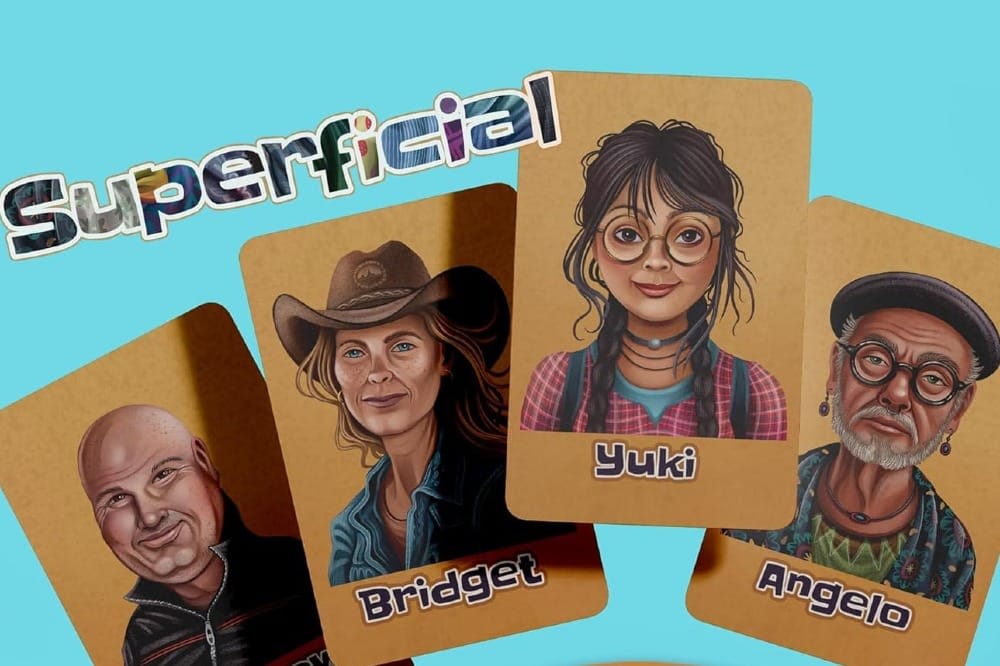
You have a box of cards of two types. On one set there are dozens of faces with names, just like you see above. Men and women, young and old, different hair (or no hair) different hats, clothes, jewelry, makeup, tattoos, glasses, piercings, colors. It’s nicely randomized. In the other set of cards are superficial questions that, with various degrees of certainty, you may be able to guess based on looks alone.
The play goes like this. One person (call them the Oracle) picks a random Face card and puts it back into a shuffled subset of 30 (There are 90 face cards). They memorize and typify that person in their head, gives them a backstory based on the vibes they get from looking at them. The dealer then spreads the subset of 30 into a six by five array, like Old Maid, but all face up.
Everybody else takes turns to pick a Question card and picks the question they think will eliminate the other faces. The Oracle answers either yes or no. Now there is sixty seconds for the other players to eliminate the other face cards. At the end of the round, the Oracle will say whether or not play continues. Play ends if the selected face was turned over.
The object of the game is to ask the right set of questions, so that everyone can agree with the vibe that the Oracle selected and not eliminate that face. Everybody is on the same team.
This game is hilarious and silly and deep at the same time. There are many levels to consider, but it dovetails very much with Pinker’s new book which I still cannot manage to squeeze in time to finish. It’s a kind of game theory process of elimination within reasonably simple rules which attempts to get people to attribute unknowable characteristics to a ‘person’ who is not real. You, as the Oracle, also have to game yourself by trying to guess what other people might guess. So it’s about stereotyping base on appearances. But you can never say that you actually know the person.
In my case I had “Jasper” a tanned young man with long brown hair, green eyes, full beard and two earrings. I didn’t notice the earrings. But he immediately reminded me of a young handsome Dave Grohl. In my mind he was a healthy surfer and hiker from Southern California, mellow, cheerful and at ease with people. We got through several rounds until we got to the question “Does this person take selfies at the gym?” I said no. But the women I was playing with all agreed that he’s too good looking not to take selfies at the gym. My daughter said, of course he’s conceited, look at his plugs. No wait. He did have two earrings the same color as his eyes. They’re not plugs, but yeah he would be conceited.
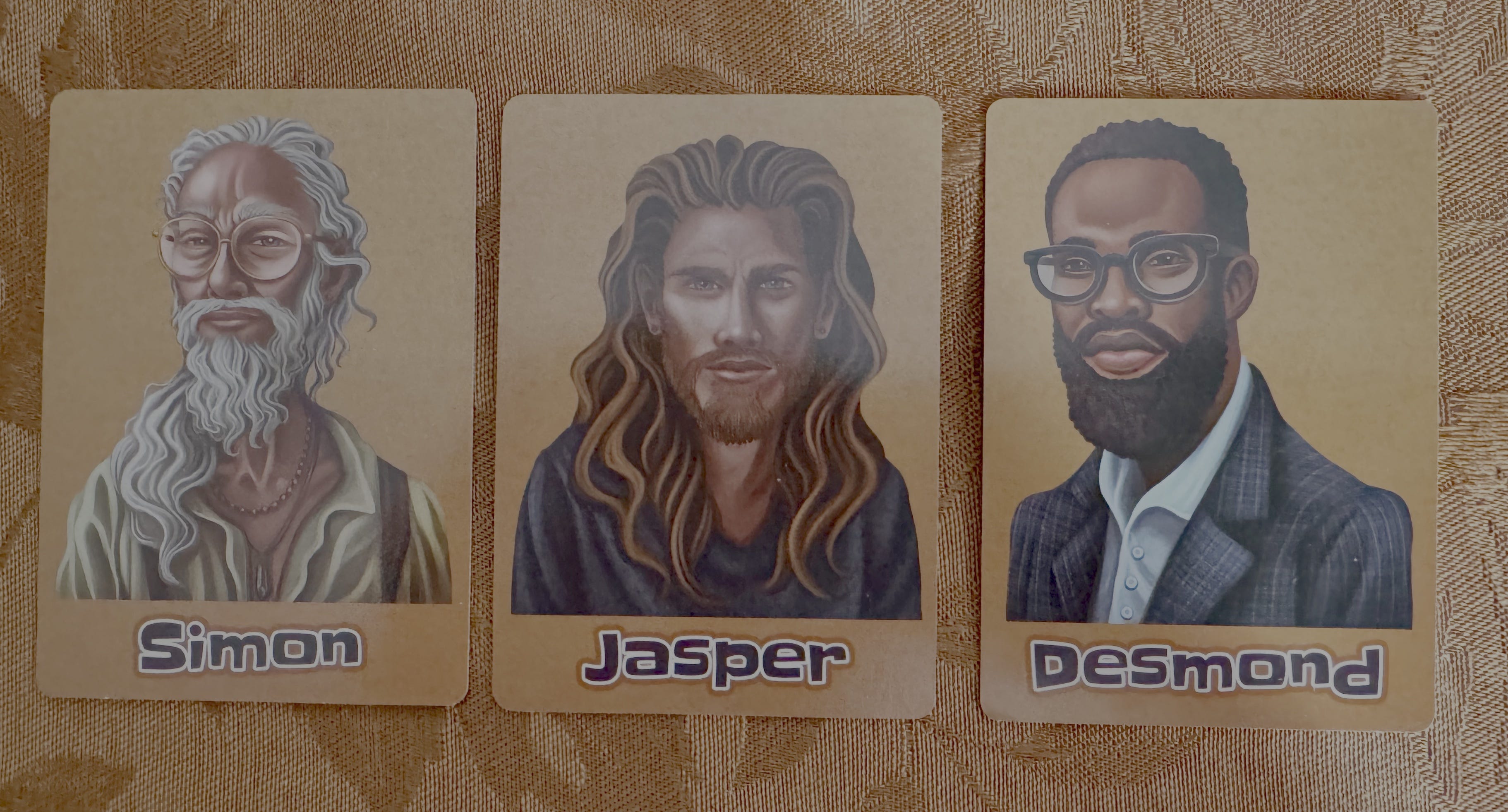
I took this picture while counting the actual number of face cards and it turns out that in the context of playing the game and taking a superficial look at Jasper, I missed a couple things. First of all he doesn’t have the shoulders one would expect of a surfer. He’s not as healthy as I expected. Interesting how that works - how your perceptions of a fixed thing can change over time given that you overlooked one thing that others find significant, and imagined one thing that a second look doesn’t confirm.
Even as I took this picture only 10 minutes ago, I wanted to present the idea that I’m some blend of these three men. The analytic unsmiling Desmond in corporate gear whose eyes are not looking at you. The wise ancient peaceful Simon who has a bag of unknown goodies slung over his left shoulder. He looks at you directly but his head is turned in another direction. The cool Jasper who, dammit, wasn’t who you thought he was. Not at one with nature, just conceited with his eye-matching earrings. Now I hate you, you little bitch.
Not It. Saying It.
There weren’t any cards that were Dad enough or strong-silent enough, so Superficial doesn’t give enough archetypes for me. That’s the point. It’s almost close enough to game and win, but also infinitely variable depending upon who is playing and what their priors might be, even about the point of playing the game itself. How long could you do it and keep laughing at yourself?
Indeed how many pictures do you have of yourself that you think conveys something true about your inner beauty? If we hadn’t been so rudely interrupted by the murder of the century, we might all be reflecting on our aims for this new year.
When we were kids, we played variations of tag. Somebody would have to be It. When you’re a child, role playing is so crucially important. When you knew that in a short time, somebody else would have to be It, then it wasn’t so important being It and having everyone run away from you even though the game flirts with the kind of cootie filled alienation that is high on the nightmare scale. Imagine being It two or three times in a row, or the infinite It when you’re the slowest or smallest and incapable of catching anyone else.
At the start of the game of tag, you might try the “Not It” tactic. Calling “not it” is like the game of spoons. Action always beats reaction, and the last reaction loses and becomes It.
The solution was the “Saying It” call, in which generally a more clever kid gets everyone to put their feet into a circle and calls the rhyme that eliminates each foot to determine who’s it. And I’m thinking about the person who (like me) tries to calculate which foot they will pick.
Bubblegum Bubblegum in a dish..
My mother and your mother were hanging the clothes..
If you can’t stand the idea of being It, as an adult, then you will make sure to call the rhyme and pick the rhymes that count your feet out.
Today’s Stoic Introspection
Ask yourself if you mind being It temporarily as an adult. Ask yourself if you are playing superficial games and trying to make sure somebody else is It. Ask yourself if you are perversely trying to be It.
Nice use of an every day card game to reveal deep truths.