

The Tool Aesthetic
Where peasants rule.

I think I met the dude who calls himself the Ivy Exile, but I’m not sure. Here’s the thing. I’m a writer. I write code and I write essays. They’re all for people at some end of a computer screen because I haven’t been published in book form as of this moment. And when you think about it, it’s a rather blue collar thing to do. Let me not belabor the point that geeks and nerds are not cut from the same cloth as trust-funders; not that there’s anything wrong with that.
As a writer, I am different from a scholar or an academic in that (and I just learned this key distinction) that I am not in the institutional business of producing knowledge. When I think I met the Exile we were chumming it up in Chicago at the scene of the Heterodox Academy’s 3rd annual conference. On day one of said conference, just before I learned that key distinction, I was fuming mad at the amount of patience these conferees had and the stark raving idiocy that has pervaded their territory of the Humanities. I simply could not understand why everybody in the joint wasn’t raving like Sam Kinnison. And then the boss said “We are in the business of producing knowledge.” Thus, I recognized how exactly that meant a certain amount of patient explication about exactly how every thought goes right or wrong in the complex process of debugging every frigging idea that wafts through the heads of dullards, undergraduates, post docs, genius emeritii and all points in between. I have way less patience than that - and I have no interest in sniffing that amount of bodewash and excreting MLA citations out Wazoo way.
So I’m so thrilled when the Exile expresses similar disdain to the various travesties of higher education. I think of him as an entrepreneur on the outs from Academic America as I think of myself as an entrepreneur on the outs from Corporate America. It’s not that we are opposed to the idea of such institutions, it’s just that they’ve gone rotten trying to scale up infinitely. There is, basically, the same agency problem in both of these. They’re polluted by corporatism and have failed to grasp the essence of their core efficient profitability by letting too many camels into the management tent.
Because of this, we’ve managed to generate and isolate a false elite at the tops of these entities, all fueled by the condescension of popularity. As millions of Americans are slowly discovering, we’ve embraced a false kind of upward mobility. We all don’t need corporate jobs. We all don’t need college degrees. In fact, chasing those Scooby snacks just might give us more than indigestion. They may be poison. The hurrier you climb, the behinder you get. Demics and Corpos have been climbing in Escher space, and most of them are still enchanted, citing the absolute value of their steps without regard to their actual elevation above sea level.

See? I’ve said all that condensed. I expect you to get it. I can’t prove my point in the traditional way — well actually I am. I’m proving it in the way I expect well-read individuals would have done in the years before 37.5% of people age 25 or older had at least a bachelor’s degree. I can’t prove it in the new Post-War traditional way. Ask your friendly neighborhood LLM the following question:
How might it be argued that the establishment of the MLA inflated dubious scholarship?
While I argue that one should never give a nailgun to someone who is not proficient with a hammer, those of us who know the difference between a claw, a sledge and a ball peen can do good work with an AI. Get used to the fact that they are polite and don’t pretend to be people. You may miss that someday in the future.
That’s not the key question today, my friends. The key question is how we survive the corruption of everything. So for those of you who have an extra minute or 20, I pass the baton to James Pumphrey, a class-A non-yokel Peasant who is precisely the kind of educational entrepreneur that will keep our country alive and well through this and the next dark age. Pumphrey is a writer. He is also a YouTube practitioner, and he gets me right here. He has turned the corner with his brand, Speeed, which used to be all about automobiles, but now is into new territory. If you didn’t know him, but you know Rick Beato, then you should have an idea of what kind of particular peasant chops he brings.
The short answer, I propose, is the Tool Aesthetic. Next I’m going to start ranting about this, as if I always knew what I know.
Seiko 6309-7049
Some of my oldest fans remember me from my shameless cringe-style Dad Bod days when I first engaged my EDC passions and calculations. Today I feel that I have done with my appearance what I equivalently did with my old lower-case online rants in places like The Well. I have cleaned up for posterity. But one of the old passions shining through that I have long held is a love for watches. Recently, I’ve gotten a bit of a fever. Three years ago I was overthinking audiophile equipment. I got the system of my dreams, but I would say I bought right about at the maximum point where the marginal improvement starts to cost exponentially more money.
I probably had gone through half a dozen cheap watches before I purchased my first automatic. An automatic watch is one that you wind when you first put it on and set the correct time, and then it keeps running and you don’t need to wind it again. If you’ve always worn a quartz watch, you’d think this is nothing special, but an automatic watch doesn’t run on batteries. Automatic watches run on kinetic energy. Just twisting your wrist up to look at your watch winds it through a miracle of weights, balances, gears, springs and jewels. Upon discovering this, I was shocked into a new world, rather the same way I had previously learned about the world of motorcycles and high end audio. These were perfect complements to my love for computers, and so from the moment I purchased it in 1984 it almost never left my wrist for years. I still have it.
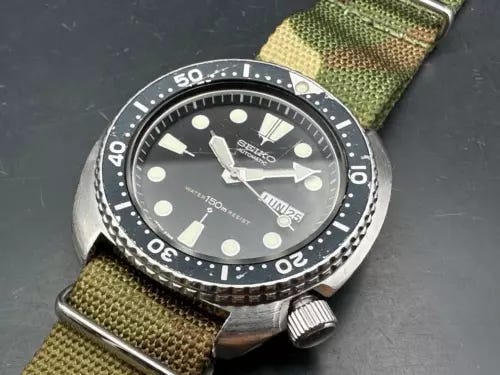
It turns out that this particular Seiko is undergoing something of a revival. This one on Ebay is going for $900. There’s something magically rugged about this small, 40 year old machine. Yes you can still get them repaired, unlike most things consumers can buy. This is a diver’s watch, meaning if you do SCUBA, you can take it down with you and it remains water resistant, as it says, down to 150 meters deep in the ocean. You rotate the bezel so you know how long you’ve been under.
In the watch world these are the tool watches. These are utilitarian. Clean, functional, robust. Tool watches include pilot watches, field watches and divers like the one above.
One of the most popular field watches now is something called the Hamilton Murph. It was the watch made famous by Matthew McConaughey in the film Interstellar. A field watch is slightly different than a diver, it generally won’t have the rotating bezel, but it will still be water resistant. It won’t have polish and it’s more likely to have a natural strap than a metal bracelet. Now it must be noted that without irony there are such things as luxury tool watches, and the Murph is an example. They are called field watches because they were generally the watches issued by armies - to be used on the battlefield.

But the aesthetic is clear. It symbolizes form and function in balance. Not coincidently, it will last a lifetime. The technology of automatic watches has been perfected and today you can get something that just works. The catch here is that most everyone carries a cellphone and technically speaking such folks don’t need wristwatches. You get a tool watch because it is mechanical and you appreciate the machine.
You can get a Seiko Five, which is one of the most popular brands for under $250. I have several. I got my first seven years ago when they only cost $75. Seiko has gone upmarket and quite frankly watch prices, especially luxury watches (which these are not) have risen with the price of Bitcoin. There’s a lot of geek inflation.
Still, I’m going to continue covering the Tool Aesthetic as a peasant practitioner. Stay tuned.
I thought for a while that I might like a Rolex, but for sentimental and practical reasons decided to stick with the self-winding Timex Day/Date my father wore when he died. Ship of Theseus style, I'm still wearing the same watch, though there have been a few cleanings, part & wristband replacements. It's taken a licking and kept on ticking, just like John Cameron Swayze promised so long ago.