

Two Thirds
How much of society works?

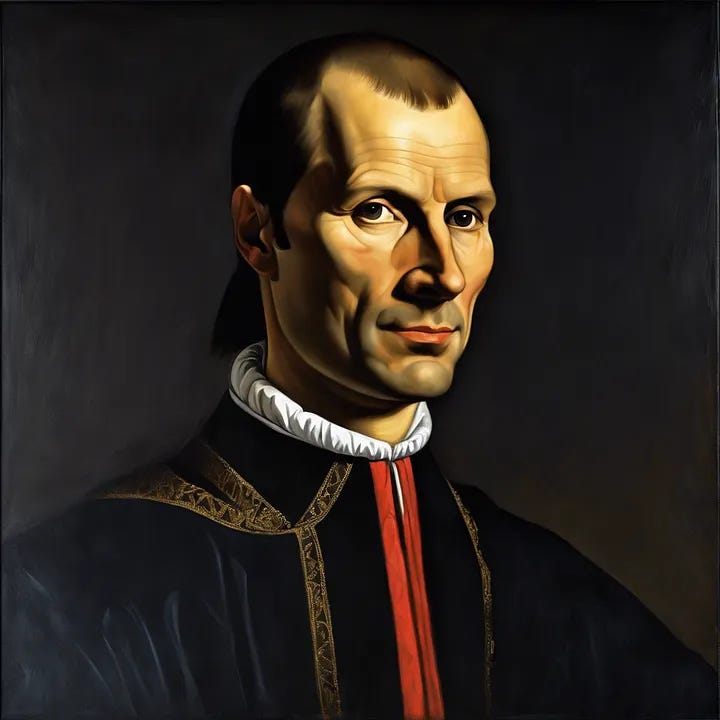
Once again I’ve been tossed out from under the bus. It started with Tyler Cowen’s interview with Harvey Mansfield who demonstrated that he knows a great deal about Machiavelli that I have never considered, that he was the man who initiated modernity. And I’m remembering vaguely salient points for James Burnham’s book The Machiavellians: Defenders of Freedom. I see in my life, I have not paid enough attention to Machiavelli.
The Journey
One of the things I haven’t described in my Stoicism is that it has served me in two ways, firstly as an escape from the falsities of political rhetoric in a populist democracy, and secondly as an exploration of what remains Western and rational that I believe citizens should respect. Yet it is in that second aspect that I have found the joy of discovery. It’s not only for civil discourse that I long, but for the enjoyment of the myriad intellectual, cultural, and even Epicurean pleasures that exist in our heritage and contemporary life. Every ghetto has borders, and so I cross them when I tire of my surroundings. I don’t pretend to be part of the power elite. I don’t expect my voice to change things but to give comfort and sustenance to people who appreciate what is delightfully available in our open society.
And yet I’m feeling as if I have not, beyond the ties of subscription, established the kind of backup I need in an unpredictable world. Whereas once in my life, I strove to be organic and unleveraged by any particular powers that be, now I find that my life’s lessons tell me how quickly I can be pauperized. This is because now I have read, at stupid long last, Machiavelli. I see where I have been foolish according to his harsh lessons. I thought my elan would be fungible, and now I see that I don’t have enough of the elemental prime movers: money, guns, lawyers, medics and 60 days of rations.
These days I feel as though Western society has become, not so corrupted that it is incapable of persisting - no nothing like that. It has become like Central Park in the 70s. A place where corruption has landed like an anvil where you expected at most a stiff breeze and autumn leaves.
Machiavelli and Modernity
Quite simply Machiavelli in the 16th century began to formalize away from the theoretical understanding of social capital as dominated by the Church towards the reality of what those ‘blessed’ were actually doing. As I’m reading his story about the rise of Castruccio Castracani of Lucca, I get a real sense of the savagery of Italian factions at the time. So if Machiavelli’s are ancient tales of Mafia-like Rules of Men, I don’t instantly say that’s the way of the world, capisce? There are, in the words of the ever-wise and sometimes too upbeat Steven Pinker , the Rules of Law and the Rules of Honor. I began thinking about the Peasant Theory in my cynical anticipation of an American reversion to feudal Rules of Honor. That is to say if and when our democratic republic’s institutions fail, as so many have, there is always the possibility that our notions of democracy itself will fail. We will then gradually slide, not to fascism as so many believe, but towards feudalism. Why? Because Americans will fight for the protection of strong Americans, whether or not they are elected officials.

If you don’t believe that, just look at which retired generals and opinion makers are put into the news streams. Look at how we regard our own oligarchs. The Rulers are real, and they’re not in Congress, and they talk about our society and we listen.
Machiavelli understood how the powerful had the necessity to cultivate broad inclusive friendships. They could not afford to be hated by the people, therefore of all the rules to follow there were specific ones they couldn’t break. Yet these were submerged under a coldly calculated diplomacy which was far from democratic. Whereas the people might smell conspiracy, the ruler will not defy the silence and secrecy necessary for his deep and shallow allegiances.
And, to reduce the matter into a small compass, I say that, on the side of the conspirator, there is nothing but fear, jealousy, prospect of punishment to terrify him; but on the side of the prince there is the majesty of the principality, the laws, the protection of friends and the state to defend him; so that, adding to all these things the popular goodwill, it is impossible that any one should be so rash as to conspire. For whereas in general the conspirator has to fear before the execution of his plot, in this case he has also to fear the sequel to the crime; because on account of it he has the people for an enemy, and thus cannot hope for any escape.
Machiavelli, Niccolò. The Prince (pp. 94-95). (Function). Kindle Edition.
The honor of the principality must be maintained even when working with weaker teams and mercenaries, for or against peers. The consent of the governed has nothing to do with that, essentially because there was so such national federation in the days of Machiavelli. Naturally, again we are talking about an era of city-states and what we nationals would call petty fiefdoms. Nevertheless, what is a corporation but a petty fiefdom? You always have to think deeply about what it means to lead 10,000 men. That’s no village, no matter how much Tim Cook says he’s Mr Nice Guy in his big round principality.
So Machiavelli to me now represents the actions of the powerful at that scale, which is something we are sadly ill-equipped to handle in the modern WEIRD middle class. Even among the affluent, there is a different kind of person to be when those even mildly ‘sworn’ to allegiance reach that scale. We peasants manage friendships and relationships, as we should. But our necessary emojis and sentiments do not scale, nor do our responsibilities. This is why we are subject to power. We don’t understand how it works by these Machiavellian principles which are in a manner of speaking the essence of the beginning of the Enlightenment.
We might think all we need is to be Christlike in our Christian ethics. We might think all we need is to submit to the will of Allah. We might think all we need is to detach ourselves as would Buddha. These are all peasant ethics that would squander power in the face of the reality of what men do. There is no turning of cheeks in the rationale and logic of power.
I believe that many wise Americans do actually understand this, some because they are powerful, some because they may have learned the hard way. Perhaps they grew up with the Classics and knew to take Machiavelli seriously. Perhaps they have led men in battle. Perhaps they have survived to lead after a hostile corporate takeover. Perhaps they like Teddy Roosevelt had the experience of dealing with powerful, hostile political opponents. This is why I believe those who have been successfully powerful under the Rule of Law know it to be in their interest that we remain a Constitutional Republic in fact.
But Maybe They Hedge
Long ago I read a book that told the tale of the man who was once the richest in the world, Adnan Khashoggi, known as the Great Gatsby of the Middle East. He purposefully raised on of his children as Christian and another as Muslim, so that they would be able to confidently do business in either aspect of the world.
I’ll just say this. I believe most Americans, as in the overwhelming majority of the Peasant class, are hesitant to question the legitimacy of our multi-ethnic society and American commitment to lawful immigration. Yet these same Americans expect us all to be a society of law and order - with rules for citizens that should not be perverted. This even though they understand the level of corruptions in government and their distrust of the performance of Congress, as well as the derangements of our populist politics. So Americans are trying to re-clump together in pieces and parts over the disunity of recent disappointments.
I think inevitably some of those clumps will be feudal, and technofeudal. That’s actually easier than reforming government. DOGE or no DOGE, we all know there is waste, fraud and abuse. Still, we are seeing lots of Americans hedging their bets on the Constitution and the non-cell based politics of our electoral history. The number of underground political organizations in this country is disturbing, as is their foreign funding.
A proper citizenship can correct this hedge. Maybe it’s too late for Millennials to get their civics. They’re having their hands full with their peasant situationships. That’s not stopping Marxist outsiders from spending treasure on instantiating new codes of honor in sly defiance of the rule of law.
Is that a third of America? Let’s presume it is. Call the three parts of that third [useful idiots, calculating cads and sentimental sheeple]. A bad economy will make things worse.