

Will Durant
Only be a fan of the dead.

One of Cobb’s Rules is tangential to ‘never meet your heroes’. It says to only be a fan of the dead. It’s a bit more strict. The reason for this strictness is that you can be assured that in the complex adaptive dynamic society we live in, that you have to consider what people say in light of those incentives offered. The reason is that we shouldn’t have such a complex adaptive dynamic society as we do have a complex adaptive dynamic economy. But we have something bordering on a oligarchic economy and in order to be free of its onerous constraints we are taking more liberties in society. If you’re here you probably understand why we’re living in a dark age and why we could use a bit more honesty and integrity. Remember the Grandmother Test.

So it turns out that I’m going to continue to assume that there’s very little good streaming. What’s current is only a fraction of what’s good. I only pay attention to the interwebz for three primary reasons.
Wars and rumors of wars.
Economic booms and busts.
Friends, subscribers and partners.
Everything else is a waste of time, except for the discovery I require for my work and writing. The rest, the collective wisdom of Western Civilization and the particular edification I get from ingesting it, is not in abundant evidence online. So I’m a fan of the dead. This year, not yet in review, I have recalled four in particular.
Adam Smith
Alfred North Whitehead
Bertrand Russell
Will Durant
Last night I went to sleep listening to my new audiobook from the latter. This morning I was startled awake by the following written by Durant in 1968:
We frolic in our emancipation from theology, but have we developed a natural ethic—a moral code independent of religion—strong enough to keep our instincts of acquisition, pugnacity, and sex from debasing our civilization into a mire of greed, crime, and promiscuity? Have we really outgrown intolerance, or merely transferred it from religious to national, ideological, or racial hostilities? Are our manners better than before, or worse? “Manners,” said a nineteenth-century traveler, “get regularly worse as you go from the East to the West; it is bad in Asia, not so good in Europe, and altogether bad in the western states of America”; and now the East imitates the West. Have our laws offered the criminal too much protection against society and the state? Have we given ourselves more freedom than our intelligence can digest? Or are we nearing such moral and social disorder that frightened parents will run back to Mother Church and beg her to discipline their children, at whatever cost to intellectual liberty? Has all the progress of philosophy since Descartes been a mistake through its failure to recognize the role of myth in the consolation and control of man? “He that increaseth knowledge increaseth sorrow, and in much wisdom is much grief.”
Durant, Will; Durant, Ariel. The Lessons of History (p. 91). (Function). Kindle Edition.
I highly recommend this audiobook. It’s narrated by the ever excellent Grover Gardner whose work with Mark Twain is just stellar.
The wonderful thing about being well-read and well-traveled is that you don’t have to be cynical. You can always be merely skeptical, because ultimately if you listen long enough, people will tell you who they are. The trick is recognizing there is no trick. It all comes out if you simply pay attention. We are an evolutionary success. We know how to read the world. Or as entrepreneur Jimmy John says, how do we know if a wine is good? If we like it, it’s good. You simply have to try enough wine to find one you like. That’s the good wine.
It reminds my of my grandfather who was house manager of an upper-crust fraternity back during the old WASP hegemony. I asked him how I would know if the sommelier has brought back a wine appropriate for the meal. His reply, “If he serves you what you asked for.”
These four titanic intellectuals of Western Civ most likely have all the answers I could ever ask about life. I actually expect that at some point in the future I will understand a bit more about Claude Shannon, John Von Neumann and Vannevar Bush too but I won’t write about them here. It’s kind of all I need to know.
In all of that wisdom is the lonely grief of knowing. But there’s always good wine.
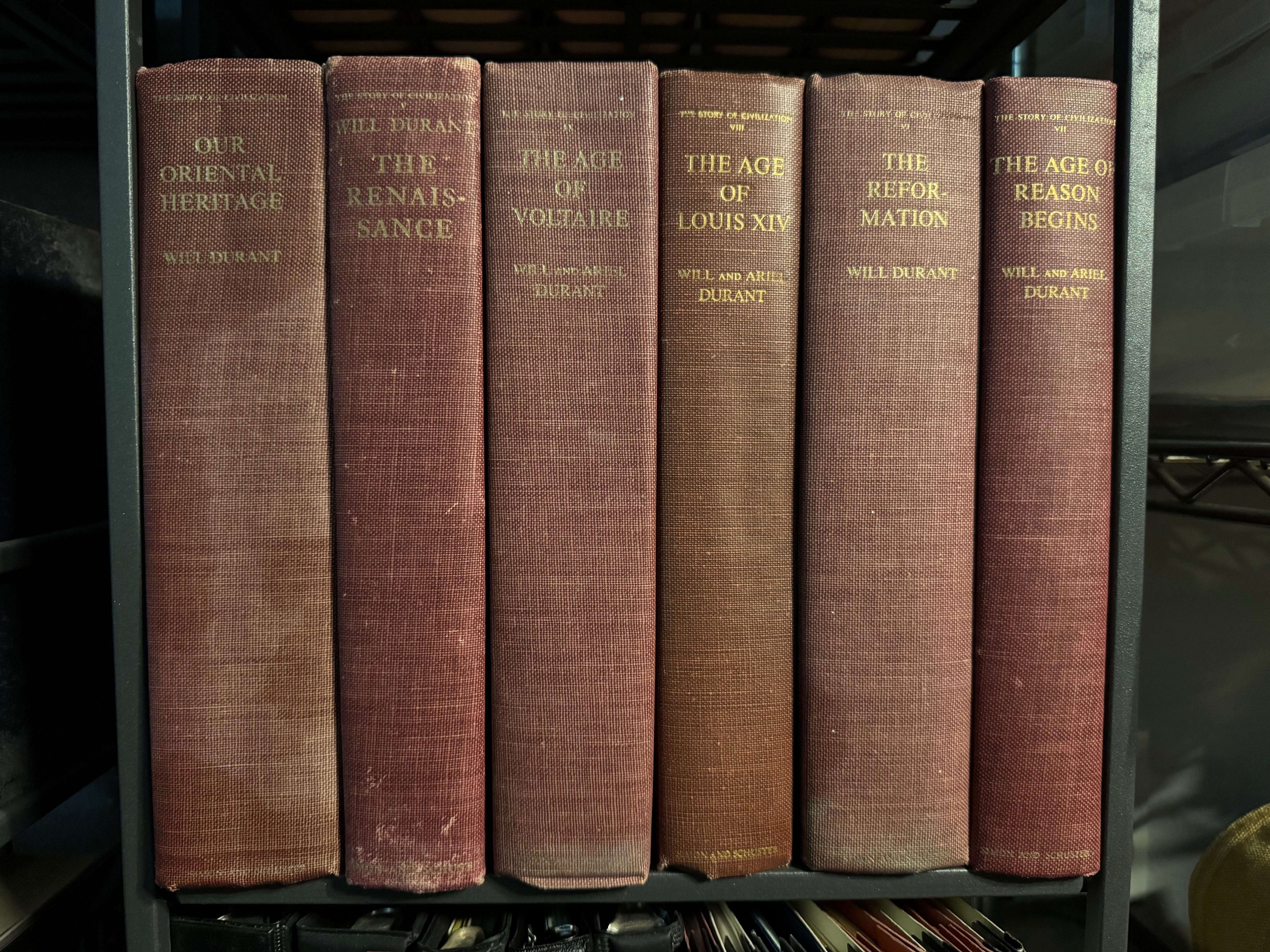
Durant's "Story of Civilization" was on the net in pdf at one time. I have all 11 volumes in hard copy. His irreligiosity gets tendentious at times, but the series is worth reading.
I love "The Story of Civilization"!
I haven't read all of it, but I've read all of "Our Oriental Heritage", some of "The Life of Greece", most of "Caesar & Christ", some of "Rousseau & Revolution"; and almost all of " The Age of Napoleon".
I still have a lot to go.